

According to recent update, Aave has surged to the top of decentralized finance by a historic margin, leading all protocols with $22.4 billion in active loans.
What makes this milestone striking is not just Aave’s absolute size, but its dominance. The data shows that Aave now exceeds the combined active loan volume of all other listed DeFi lending protocols, underscoring a clear consolidation of on-chain credit activity.
Aave Pulls Far Ahead of the DeFi Lending Pack
The chart tracks average weekly active loans over the past 365 days, revealing a steady expansion in total DeFi credit before a recent moderation.
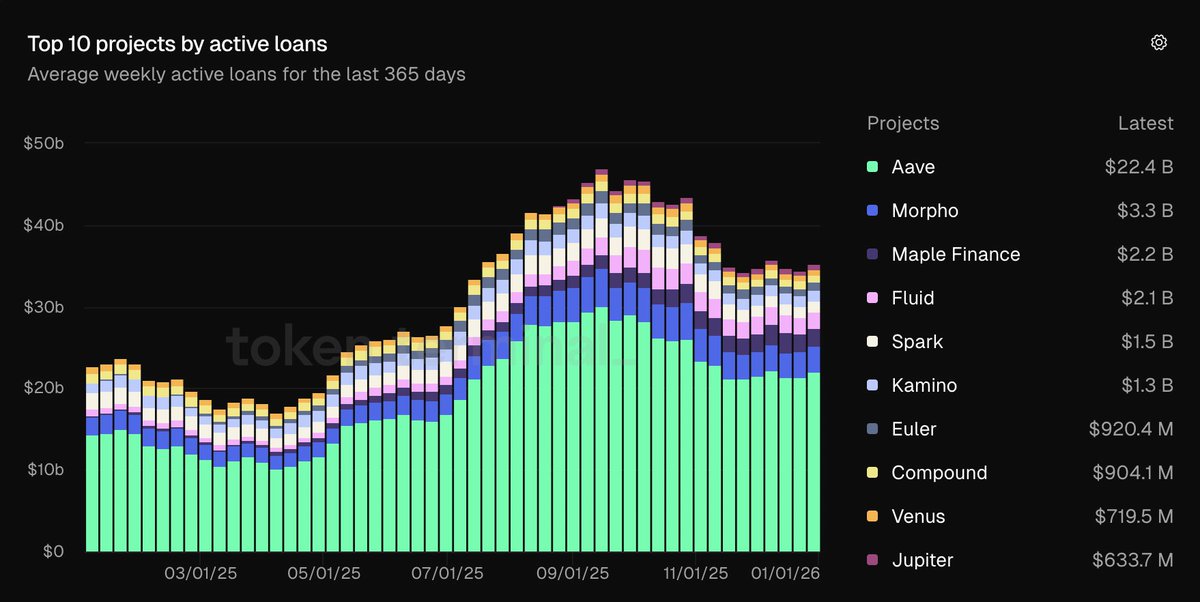
Throughout this cycle, Aave consistently accounts for the largest share, with its green bars towering over the rest of the stack.
At the latest reading:
- Aave: $22.4B
- Morpho: $3.3B
- Maple Finance: $2.2B
- Fluid: $2.1B
- Spark: $1.5B
Even when combined with other major players such as Kamino, Euler, Compound, Venus, and Jupiter, the total still fails to surpass Aave’s lending book.
What the Chart Reveals About DeFi Credit
The stacked bars show that while overall DeFi lending expanded sharply into late 2025, Aave captured the majority of that growth, reinforcing its role as the primary liquidity venue for on-chain borrowing.
As the broader market cooled toward early 2026, total active loans declined modestly, but Aave remained structurally dominant, maintaining a significantly higher base level of activity than any competitor.
This suggests that liquidity, trust, and borrower preference are increasingly concentrated, rather than evenly distributed across protocols.
Why This Matters for DeFi
Aave’s position highlights a shift within decentralized finance:
- Borrowers gravitate toward deep liquidity
- Capital efficiency favors established venues
- Risk consolidates into fewer, systemically important protocols
Rather than a fragmented lending landscape, DeFi credit is starting to resemble a hub-and-spoke model, with Aave firmly at the center.
The Big Picture
With $22.4 billion in active loans, Aave is no longer just the largest DeFi lender, it is effectively the backbone of on-chain credit markets.
The gap between Aave and every other protocol combined marks a defining moment for DeFi, signaling maturation, consolidation, and a clear hierarchy in decentralized lending.
As DeFi evolves, the question may no longer be which protocol leads, but how the rest adapt to Aave’s scale.