



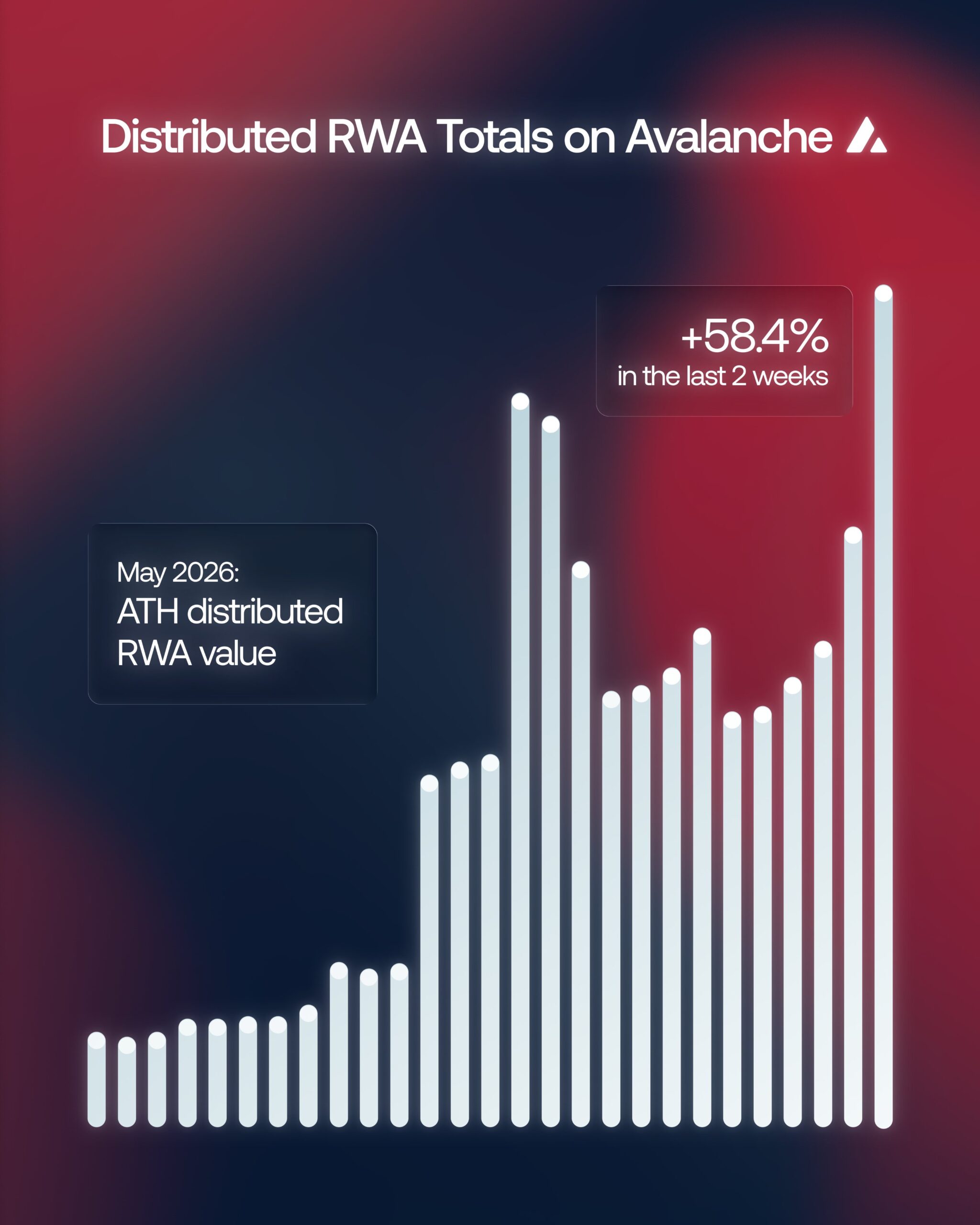
- Avalanche distributed RWA value hit $1.16B on May 25 after rising 58.4% in two weeks, led by BlackRock’s fund.
- Avalanche Team1 now has 450+ members in 40+ countries, with 600+ events and partnerships across 130 universities.
Avalanche has reached a new all-time high in distributed real-world assets, with the network’s RWA total rising 58.4% over the past two weeks. The distributed RWA market reached $1.16 billion, its highest level so far.
These products use Avalanche to move beyond simple onchain recordkeeping, as investors can gain direct access to tokenized financial products through blockchain-based rails.
The latest growth came mainly from BlackRock’s USD Institutional Digital Liquidity Fund, which accounted for $624.87 million of the total. The fund remained the largest listed asset on Avalanche’s RWA dashboard and represented more than half of the network’s distributed RWA value.
Janus Henderson Anemoy AAA CLO Fund ranked second with $258.99 million. Other listed assets included Galaxy CLO 2025-1 Class B with $46.40 million, BENJI with $36.88 million, and Diversified Fixed Income Strategy Vault 2 with $35.03 million. Sierra LP Strategy Vault also held $23.65 million, while Republic NOTE reached $18.84 million.
The data points to rising use of Avalanche for institutional-grade assets, private credit products, liquidity funds, and yield-focused vaults. These products bring traditional finance structures into blockchain environments while keeping investor access tied to wallets, custodians, and digital asset infrastructure.
Avalanche has also entered the stablecoin big leagues after becoming the tenth-largest network by stablecoin supply. Its stablecoin supply rose 16.35% over the past week to $1.66 billion, while BlackRock’s BUIDL fund ranks among the largest tokenized assets on the network.
Avalanche RWA Growth Aligns With Team1 Expansion
Avalanche’s RWA growth comes as the Avalanche Foundation opens applications for the latest Avalanche Team1 cohort. Team1 is a global community program focused on education, events, content, and support for builders and new users across the ecosystem.
The Avalanche Foundation is delighted to see @AvaxTeam1 open applications for their latest cohort 🔺
Team1 is a global community program dedicated to growing the Avalanche ecosystem through education, events, content, and direct support for builders and newcomers.
Since its… pic.twitter.com/HHgWrauVHo
— Avalanche Foundation 🔺 (@AvalancheFDN) May 27, 2026
Since its launch, Team1 has grown to more than 450 members across over 40 countries. The program has also created six official chapters, hosted more than 600 community events, and worked with 130 universities. Avalanche Foundation said the program has reached more than 75,000 Luma subscribers, with monthly growth of 15%.
Six country chapters have launched this year, with more expected before the end of 2026. The Foundation described Team1 as a community-led effort that helps support ecosystem activity at local and global levels. The program aims to bring more users, builders, students, and educators into Avalanche through direct engagement.
The timing places Avalanche’s institutional and community activity in the same frame. On one side, RWA totals continue to climb as major funds use Avalanche for distribution. On the other hand, Team1 is widening the network’s reach through education, country chapters, and ecosystem events.
Avalanche’s distributed RWA dashboard also shows a broad mix of assets below the largest funds. These include USDC Liquidity Vault 1, Prime Plus Vault, USDC PayFi Lending Vault, Delta Wellington Ultra Short Treasury On-Chain Fund, and Investment Grade Commercial Paper Vault. Smaller entries also include Apollo Diversified Credit Securitize Fund, ParaFi Venture II Securitize Fund, and OpenTrade Fixed Term E.U. Bonds Vault.
This spread shows that Avalanche’s RWA market does not rely only on one product type. Liquidity funds, credit funds, Treasury-linked products, lending vaults, and commercial paper products all appear on the network. However, BlackRock’s fund remains the main driver of the latest increase.