






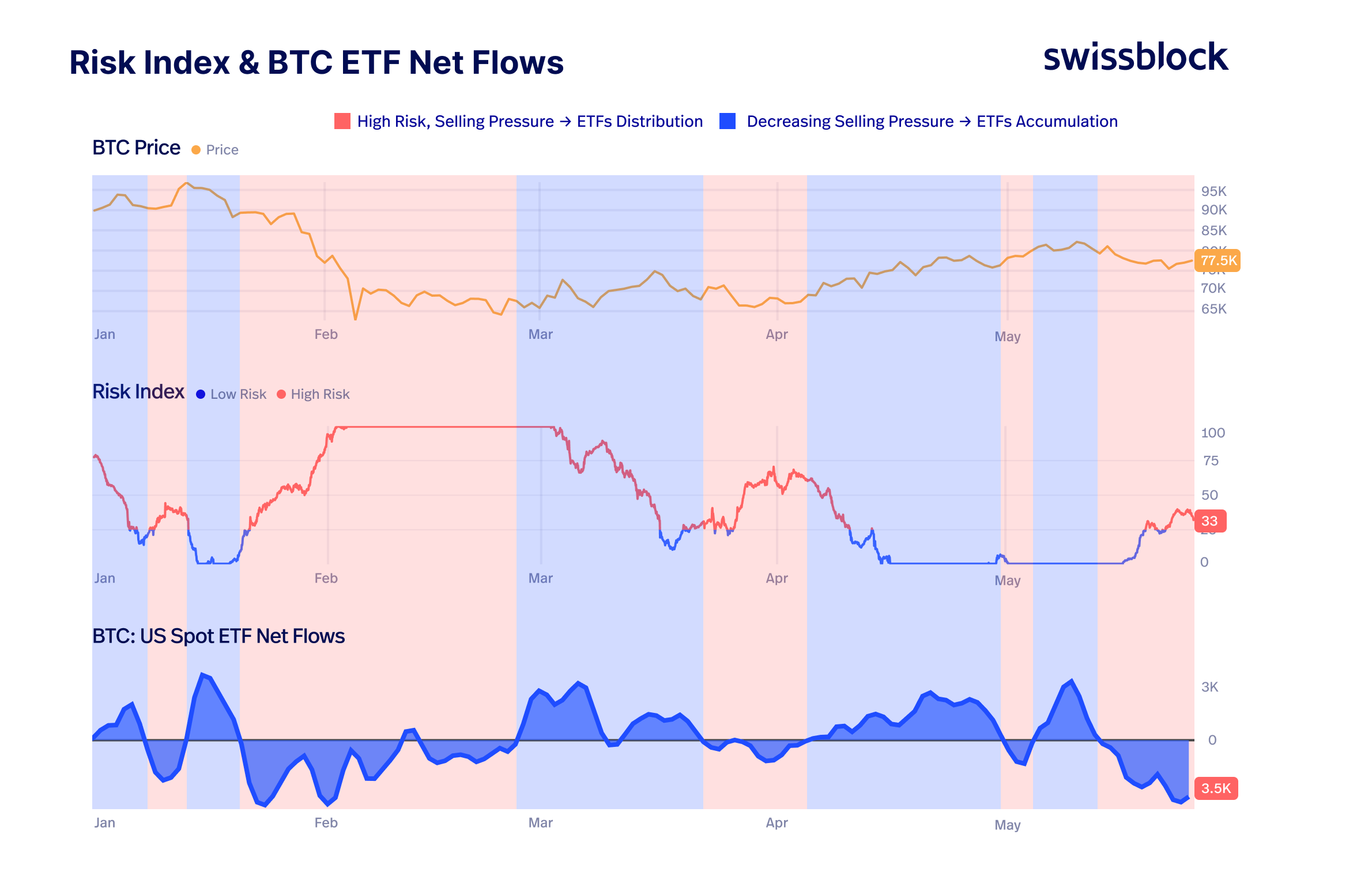
- Swissblock says its Risk Index shows selling pressure is overwhelming the Bitcoin market, driven by institutional distribution.
- There have been only two days of net inflows into Bitcoin ETFs since May 7, as macro pressures force institutions to sell risk-on assets.
Bitcoin’s ETF safety net is gradually slipping away, and it’s piling pressure on the crypto’s price as the Risk Index hits its highest level since mid-April, Swissblock says.
The Swiss crypto markets research firm revealed that institutions currently move the BTC market, and when they sell, the entire market crumbles. It noted:
“Every time the Risk Index signals that selling pressure is structurally overwhelming the market, what sits underneath is institutional distribution.”
This selling pressure has piled on over the past month as Wall Street dumps BTC following weeks of macro pressure, brought on by renewed fighting in Iran (despite Trump announcing a peace deal just a few days ago) and rising yields on US Treasuries, which is forcing institutions to sell liquid assets to cover their losses.
ETFs have long been the safety net for Bitcoin; BlackRock’s IBIT alone recorded $25 billion in net inflows last year. These investors continue to accumulate even when the prices are on a downtrend and retail buyers are dumping.
However, this is changing. Since May 7, there have been only two days of net inflows to these ETFs, and they only brought in a combined $158 million. In contrast, five separate days since then have seen outflows of over $230 million.
Swissblock revealed that while the overall flow this year is still positive, the margin is thin and could flip negative if the trend continues this week. Year-to-date, the net inflows stand at 4,500 BTC.
Swissblock’s Risk Index is at its highest since mid-April, and the company says “it’s now moving into high-risk territory while ETF flows are deteriorating simultaneously. That tells us spot ETF demand is no longer absorbing selling pressure effectively.”
Exit from Bitcoin or Rotation Into Altcoins?
Institutional interest in Bitcoin has become one of its most important pillars as retail interest has cooled over the past year. While this group injects more liquidity into BTC markets during bull cycles, it’s also more prone to dumping BTC during periods of macro stress.
Even the biggest institutional bull, Strategy, has buckled. During its earnings report, the company revealed it could start selling its BTC, departing from its ‘never sell’ approach. Founder Michael Saylor has dressed up the announcement as a cautionary statement and insisted that for every 1 BTC they sell, they will accumulate 10.
Despite the turmoil, one analyst says that the institutional investors are rotating, not exiting. Timothy Misir, who heads research at crypto firm BRN, pointed out that while Bitcoin ETFs bleed, other coins have recorded net inflows over the past month.
However, the capital flowing into altcoins is much smaller compared to the BTC outflows. In the week ending May 22, BTC lost over $1 billion in outflows; XRP, SOL and Hyperliquid ETFs pulled in less than $110 million combined.
BTC trades at $76,770 at press time, recovering from an intra-day low of $76,472, which it hit after news broke that the US had launched a fresh attack on Iran.



