

- Chainlink controls 84% of the oracle market, while LINK still trades nearly 80% below its $52.70 all-time high.
- Chainlink adoption is expanding through CCIP, with Kelp DAO, Huma Finance, Solv, and regulated use cases adding activity.
The gap between network adoption and token price has become a major debate as Chainlink controls over 80% of the oracle market while LINK remains nearly 80% below its all-time high.
LINK traded at $10.56 today, up over 11.6% in a week, according to market data. The token market capitalization stood near $7.6 billion, while 24-hour trading volume reached $1 billion.
Although the weekly price has rallied, LINK is still trading way below its all-time highs that were recorded in 2021 at $52.70. LINK’s total supply on the market was also lower during its boom in 2021, meaning that the coin could react to the rising demand.
Today, Chainlink has more tokens circulating in the market, and additional unlocks can create selling pressure when demand slows. That supply overhang gives traders a reason to question whether LINK can revisit its former peak without a much larger market cap.
Chainlink will struggle to hit ATH again !
Hundreds of billions in DeFi TVL
Nearly $1 billion in assets just migrated to CCIP in a single week$LINK is down 80% from its ATH
👉 Price failed to hit ATH after 2021$LINK hit $52.70 in May 2021.
At the time circulating supply… pic.twitter.com/bL0ISRtNDY
— Our Crypto Talk (@ourcryptotalk) May 9, 2026
However, Lookonchain data shows the network’s non-circulating supply wallet unlocked and deposited 14.875 million LINK, worth about $216 million, to Binance. Before that event, Chainlink had completed 10 similar unlocks, and the price increased 30 days later in 9 of those cases.
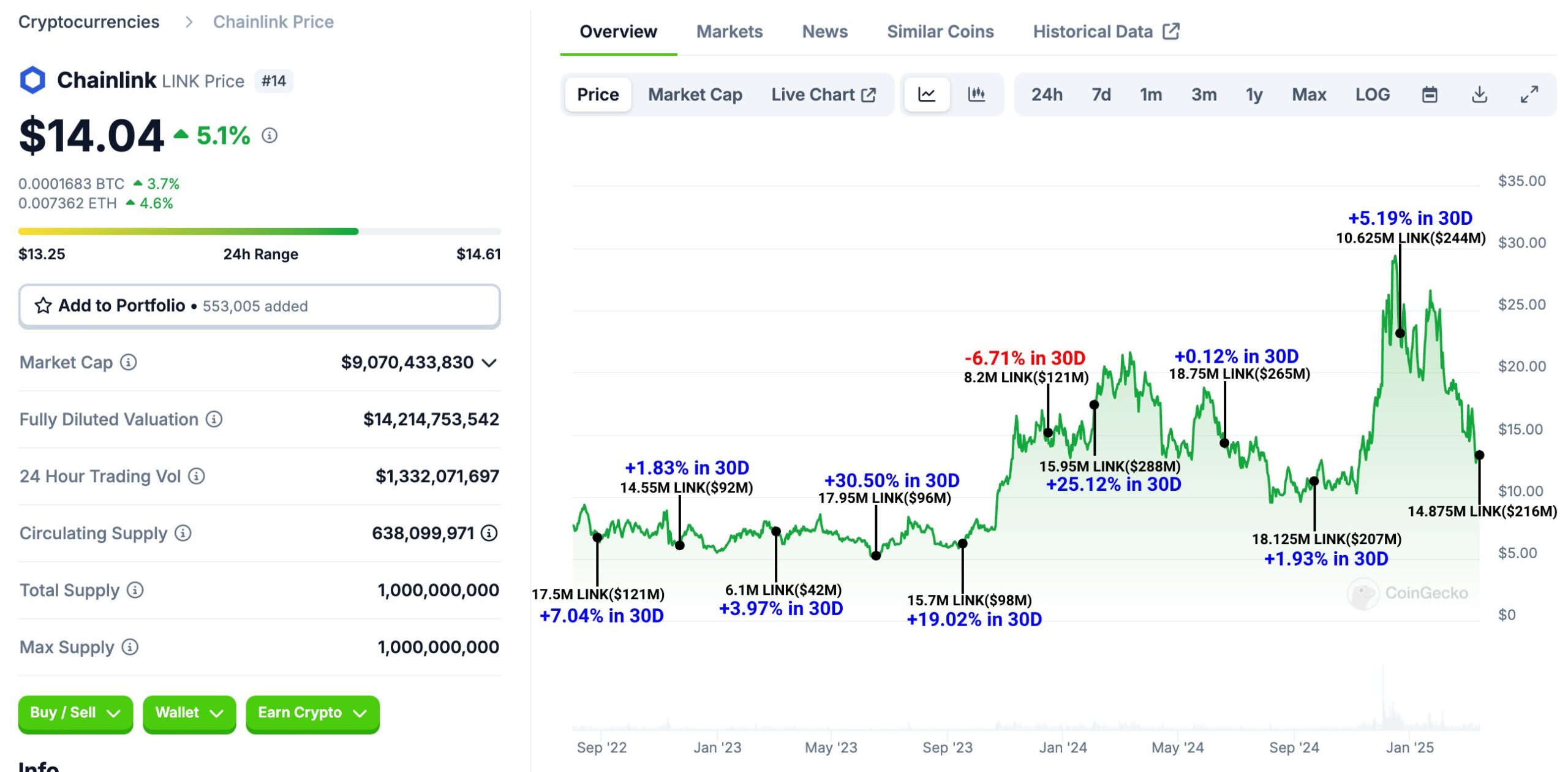
That history shows that unlocks have not always triggered lasting weakness. In several cases, LINK absorbed new supply and later moved higher.
Chainlink Adoption Keeps Expanding Across DeFi and Institutions
Chainlink’s strongest support comes from its role across DeFi, cross-chain infrastructure, and tokenized asset markets. The network secures price feeds for major lending platforms and continues to grow through CCIP, its cross-chain interoperability protocol.
Chainlink Adoption Update 🔗
Recently, there were 10 integrations of the Chainlink standard across 6 services and 14 different chains.
New integrations include @BermudaMonetary, @galaxyhq, @KelpDAO, @re, @StateStreetIM, @SolvProtocol, and @tydrohq.
LINK everything. pic.twitter.com/p1wi7yF54k
— Chainlink (@chainlink) May 10, 2026
Solv Protocol recently moved about $700 million in tokenized Bitcoin to CCIP. The move followed rising demand for more secure cross-chain messaging as tokenized Bitcoin products continue to expand across blockchains. Kelp DAO also adopted Chainlink services after concerns around bridge security, adding another major protocol to the network’s recent migration wave.
Elsewhere, CCIP is Huma Finance’s sole cross-chain infrastructure for yield products. That adoption gives Huma a standardized system for moving assets and data across chains while reducing reliance on fragmented bridge systems. It also supports Chainlink’s push into institutional-grade cross-chain finance.
The Bermuda Monetary Authority is another important part of Chainlink’s recent adoption story. Its integration supports regulatory data standards and oversight tools, linking Chainlink’s infrastructure to financial supervision and regulated digital asset activity. That type of use case moves Chainlink beyond crypto-native trading and into public-sector and institutional workflows.
Chainlink also continues to appear in integrations linked to Galaxy, State Street, Polymarket, and other projects. These integrations use its data feeds and CCIP, while others rely on it for tokenization or market infrastructure.