



- Chainlink has announced a new upgrade to its Smart Value Recapture, expanding value recovery from liquidations.
- After weeks of DeFi migrations to Chainlink due to bridge attacks, CCIP hit a new record with 80,428 daily active addresses.
Chainlink has announced an upgrade to its Smart Value Recapture (SVR) on the Ethereum mainnet, expanding the means by which DeFi protocols can recover value during liquidation events. The update adds support for parallel auctions through Flashbots and Titan.
SVR focuses on oracle-extractable value, a category of MEV associated with oracle price updates. This activity often appears during liquidations, when a new price report makes an undercollateralized position eligible for liquidation. Chainlink’s SVR design lets searchers bid for the right to backrun that oracle update. This allows part of the value to return to the DeFi protocol and the Chainlink network instead of leaking fully to outside participants.
Chainlink SVR, the most-widely adopted oracle MEV recapture solution, just got a major upgrade on Ethereum.
SVR now supports multiple orderflow auctions in parallel, including @titanbuilderxyz, increasing searcher competition & maximizing revenue for DeFi protocols like @aave. pic.twitter.com/pOO9YGMyPC
— Chainlink (@chainlink) May 20, 2026
The latest Chainlink upgrade introduces orderflow auction multiplexing on the Ethereum mainnet. Under this model, SVR can route auction activity across more than one supported provider at the same time. Chainlink says this setup can reduce inclusion delays, raise recapture rates, and strengthen system resilience by avoiding reliance on a single auction path.
Chainlink SVR Targets Oracle MEV in DeFi Liquidations
For lending markets such as Aave, liquidations can create large value gaps when oracle updates move collateral prices. Chainlink SVR gives protocols a way to capture part of that value through a controlled auction process. Aave governance previously reviewed SVR as a system built to recapture MEV from Aave liquidations and return value to the Aave ecosystem.
Chainlink SVR maintains the same aggregator interface and data structure used by standard Chainlink Price Feeds. That design reduces integration work for protocols that already rely on these feeds. In many cases, a protocol can read from an SVR-enabled feed address while keeping the same price-feed format.
The system also includes a fallback route. SVR sends oracle updates through a private path for auction activity, while standard Chainlink Price Feeds remain available as a fallback when the private route fails or times out. That structure helps protocols avoid stalled pricing data while still creating room for MEV recapture through liquidation-related auctions.
Chainlink has also expanded SVR beyond Ethereum. SVR now runs on Base, Arbitrum, and BNB Chain through Atlas, a new auction system for non-Ethereum mainnet SVR activity. Searchers that participate in SVR must integrate with the supported auction systems to improve their competitiveness across networks.
The SVR upgrade comes as Chainlink CCIP records higher cross-chain activity. Recent reports show CCIP reached 80,428 daily active addresses during the week of May 6, marking a new record for the protocol’s daily activity. The spike followed forced migrations and heavier cross-chain movement tied to DeFi security events.
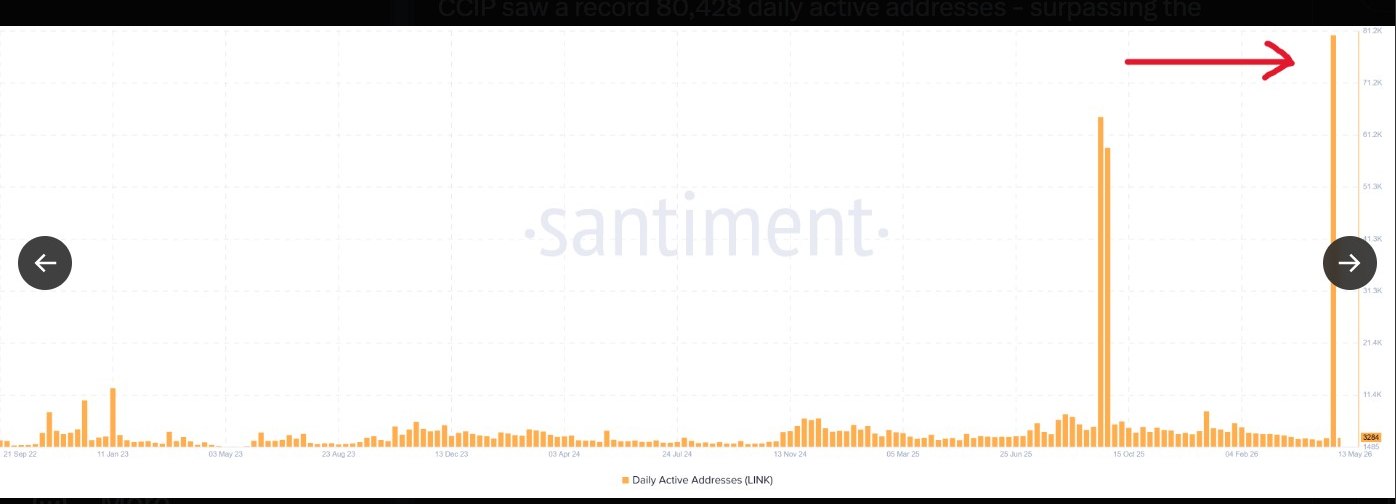
Kelp DAO activity played a part in that CCIP surge following a migration linked to a major exploit. Reports also noted that Arbitrum froze 30,766 ETH connected to the incident, while users and contracts moved assets across chains during the response. CCIP handled the added activity during a period of market stress.
ETHNews reported that during the week, Lombard dropped LayerZero and moved to Chainlink CCIP to secure about $1 billion in Bitcoin assets across multiple chains. Lombard said the decision followed a security review, with Chainlink’s independent node operators, certifications, and rate limits forming part of the shift.
Earlier in the week, Kraken also migrated its current and future wrapped assets to Chainlink CCIP after reviewing its cross-chain security needs.