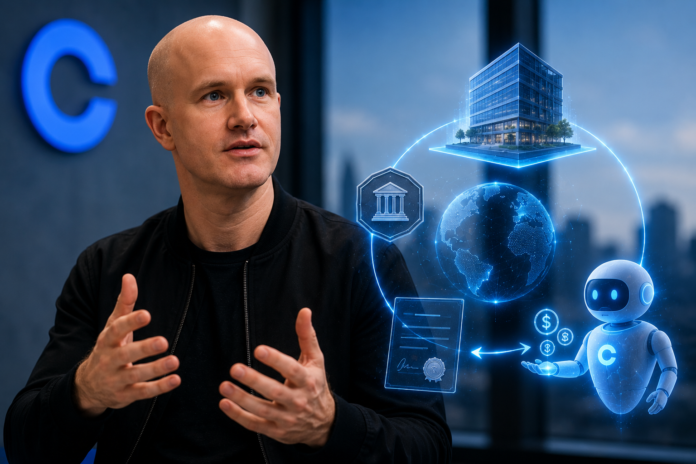

- Coinbase CEO Brian Armstrong named RWAs and agentic stablecoin payments among eight upgrades still needed in global finance.
- Armstrong linked tokenization to 24/7 trading, AI risk tools, self-custody, regulation, startup funding, and sound money.
Coinbase CEO Brian Armstrong has placed real-world asset tokenization and agentic stablecoin payments at the center of crypto’s next development phase, outlining eight areas where he says global finance still needs an update.
In a May 24 post, Armstrong said financial markets still need progress across tokenized assets, round-the-clock trading, payments, artificial intelligence, regulation, access, capital formation, and sound money. His comments arrived as tokenized real-world assets continue to expand, with market trackers placing the sector at around $37.5 billion this month.
Armstrong listed tokenization as the first priority. He pointed to real estate, stocks, bonds, and funds moving onchain to support faster settlement, fractional ownership, and wider distribution. The point fits a growing market trend, as U.S. Treasury products still lead much of the current tokenized asset demand.
Major areas where the financial system still needs an update:
1. Tokenization of real-world assets – Real estate, stocks, bonds, funds, etc. onchain for instant settlement, fractional ownership & massive distribution.
2. 24/7 Global trading – Pooled global liquidity, every…
— Brian Armstrong (@brian_armstrong) May 24, 2026
Real-world asset tokenization has become one of the clearest bridges between traditional finance and blockchain infrastructure. Instead of limiting blockchain use to native crypto assets, tokenization brings offchain assets into programmable markets. That structure can shorten settlement times, reduce operational friction, and allow smaller investors to access assets that often require larger capital commitments.
Armstrong also called for 24/7 global trading across more assets. Crypto markets already trade continuously, and Armstrong’s point suggests that broader financial markets may face pressure to move toward similar availability.
Stablecoins formed another central part of the post. Armstrong described near-instant and low-cost global transfers as a needed upgrade, including payments made by AI agents. That point connects stablecoins with automated software systems that can send, receive, or settle payments without direct human action for every transaction.
Coinbase: RWAs and Agentic Payments Lead the Next Phase
Agentic payments remain an early but closely watched area in crypto infrastructure. The idea centers on AI systems using stablecoins to complete tasks that require payment, such as buying digital services, accessing data, paying application fees, or settling machine-to-machine transactions. Stablecoins offer a direct payment rail for such activity since they can move globally and settle quickly.
Coinbase has already moved into this area through x402, a stablecoin payment protocol linked to machine payments and automated online transactions. Armstrong’s latest comments place work inside a wider financial modernization agenda rather than a narrow crypto product push.
AI also appeared as a separate priority in Armstrong’s list. He said AI-powered tools can improve risk, credit, compliance, and financial advice. In practical terms, that could mean faster fraud detection, more automated lending checks, better compliance screening, and broader access to financial guidance through digital platforms.
Last month, Coinbase launched Agentic.market, a marketplace built on its x402 payments protocol to help AI agents and users find, compare, and pay for online services. The platform gives access to x402-enabled services such as CoinGecko, Google Flights, and X without relying on API keys.
Regulation remains another major part of the agenda. Armstrong called for innovation-friendly rules that move away from broad, one-size-fits-all treatment. He pushed for risk-based oversight that allows competition while still addressing consumer protection and market risks.
That policy point comes as U.S. lawmakers continue to debate crypto market structure through bills such as the Digital Asset Market Clarity Act.
This bill faces fresh timing pressure as the Senate heads into a crowded June-July schedule without a floor vote. The bill may slip further if lawmakers prioritize other legislation before the August recess and the November midterm cycle.
Armstrong also named expanded access as a needed upgrade. He linked open protocols and self-custodial wallets with lower reliance on middlemen. In his view, anyone with a smartphone should be able to access more financial services through digital networks.
Additionally, Armstrong said fundraising should become lower-cost and easier for people with strong ideas. That goal reflects a wider crypto argument that tokenized markets and onchain platforms can reduce barriers for startups and smaller issuers.
Sound money closed the eight-point list. Armstrong described it as a refuge from inflation when discipline weakens in fiat systems. With that point, he placed crypto’s original monetary argument beside newer themes such as RWAs, AI, stablecoins, and global market access.
Armstrong said the work remains unfinished until these systems serve users broadly. He added that technology innovation and policy work both need to advance before these upgrades reach a global scale.