






Ethereum continues to show structural resilience despite persistent selling pressure in derivatives markets.
A new report shared by CryptoQuant highlights a growing divergence between aggressive futures activity and stable spot-driven price behavior.
Futures Aggression Remains Dominant Since Mid-2023
The ETH Net Taker Volume (30-day moving average), analyzed by CryptoQuant contributor Carmelo Alemán, shows that futures market participants have dominated order flow for an extended period. Since mid-2023, the metric has remained largely in negative territory, signaling that market orders are skewed toward aggressive selling, short positioning, and long liquidations.
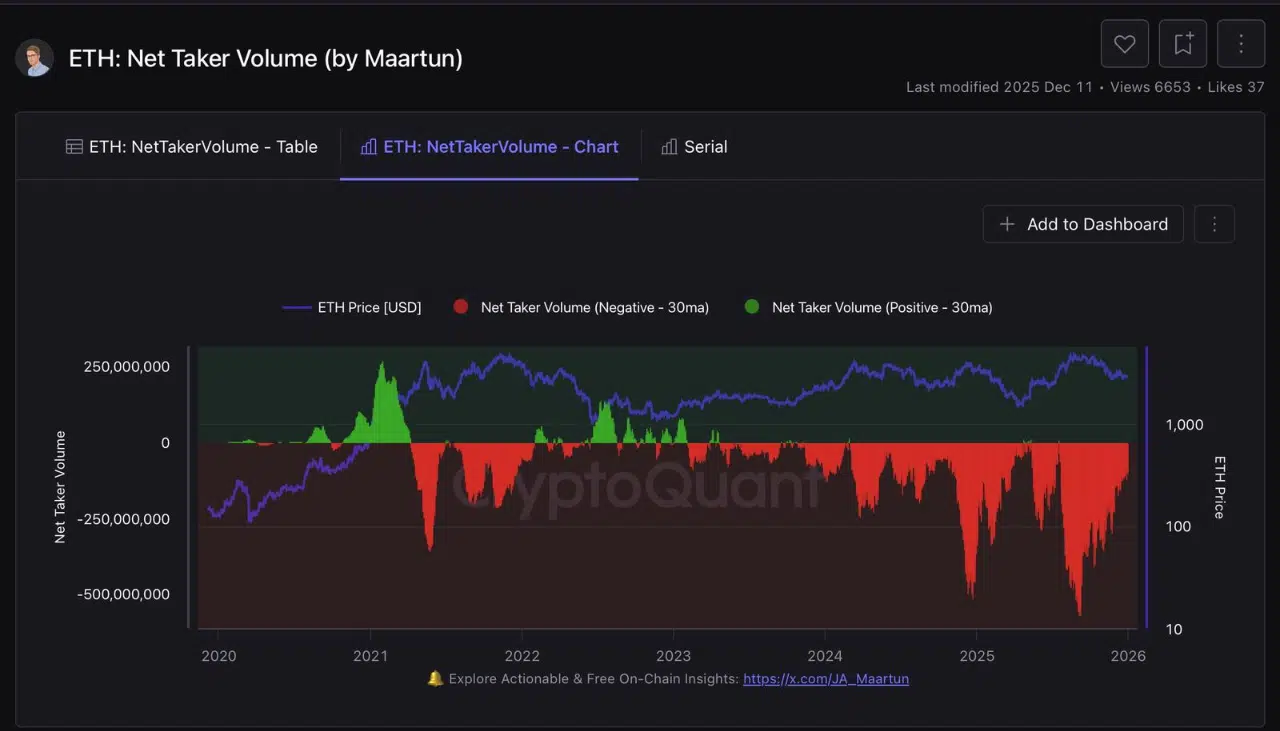
This pattern is clearly visible in the chart, where red bars consistently outweigh green ones. At the end of December 2025, net taker volume remained deeply negative, reinforcing that derivatives traders continue to apply pressure rather than chase upside momentum.
Under a purely derivatives-led framework, this level of sustained selling would typically translate into prolonged price weakness.
Price Refuses to Break Despite Heavy Selling
However, Ethereum’s price behavior tells a different story. Despite the dominance of futures-driven selling, Ethereum has managed to remain structurally stable, repeatedly holding near the $3,000 level even during periods of maximum negative taker volume.
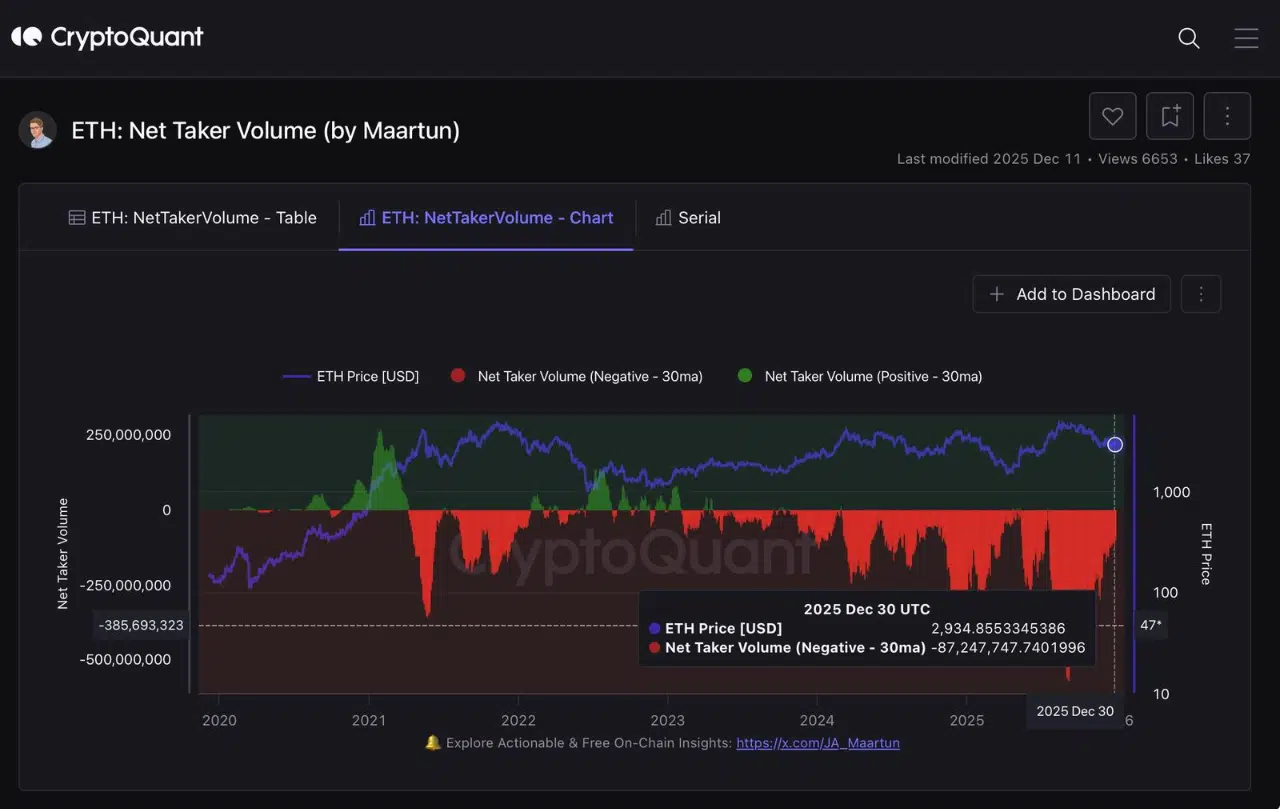
The chart shows ETH price (blue line) moving sideways to slightly higher while net taker volume stays negative. This divergence suggests that selling pressure from derivatives is not dictating the final price outcome, an important signal for market structure analysis.
Spot Market Quietly Absorbs the Pressure
According to the report, this stability can only be explained by passive demand from the spot market. While futures traders dominate short-term aggression, their impact is being offset by steady spot buying, either through direct market purchases or OTC flows.
This absorption does not appear directly in the net taker volume metric, but its presence is evident through one undeniable fact: price does not collapse. The report draws a parallel to historical Bitcoin accumulation phases, where heavy derivatives pressure failed to push prices lower due to persistent spot demand operating in the background.
Who Really Controls Ethereum’s Price?
The key takeaway from CryptoQuant’s analysis is structural. Futures markets control short-term volatility and aggression, but they do not define Ethereum’s long-term direction. That role remains with the spot market, which acts as a counterbalance, neutralizing selling pressure and preventing shorts from establishing a sustained bearish trend.
As long as this dynamic persists, aggressive futures selling translates into compression and absorption, not structural weakness. Price control, for now, remains outside the derivatives arena, a signal that Ethereum’s underlying demand continues to quietly support the market despite noisy short-term flows.



