


Grayscale’s latest market report suggests that Bitcoin may be entering a new structural era, one where the familiar 4-year boom-and-bust rhythm no longer defines price behavior.
Instead of parabolic peaks followed by deep resets, the firm argues that a more mature, ETF-driven market is reshaping Bitcoin’s long-term trajectory.
A Cycle Losing Its Influence
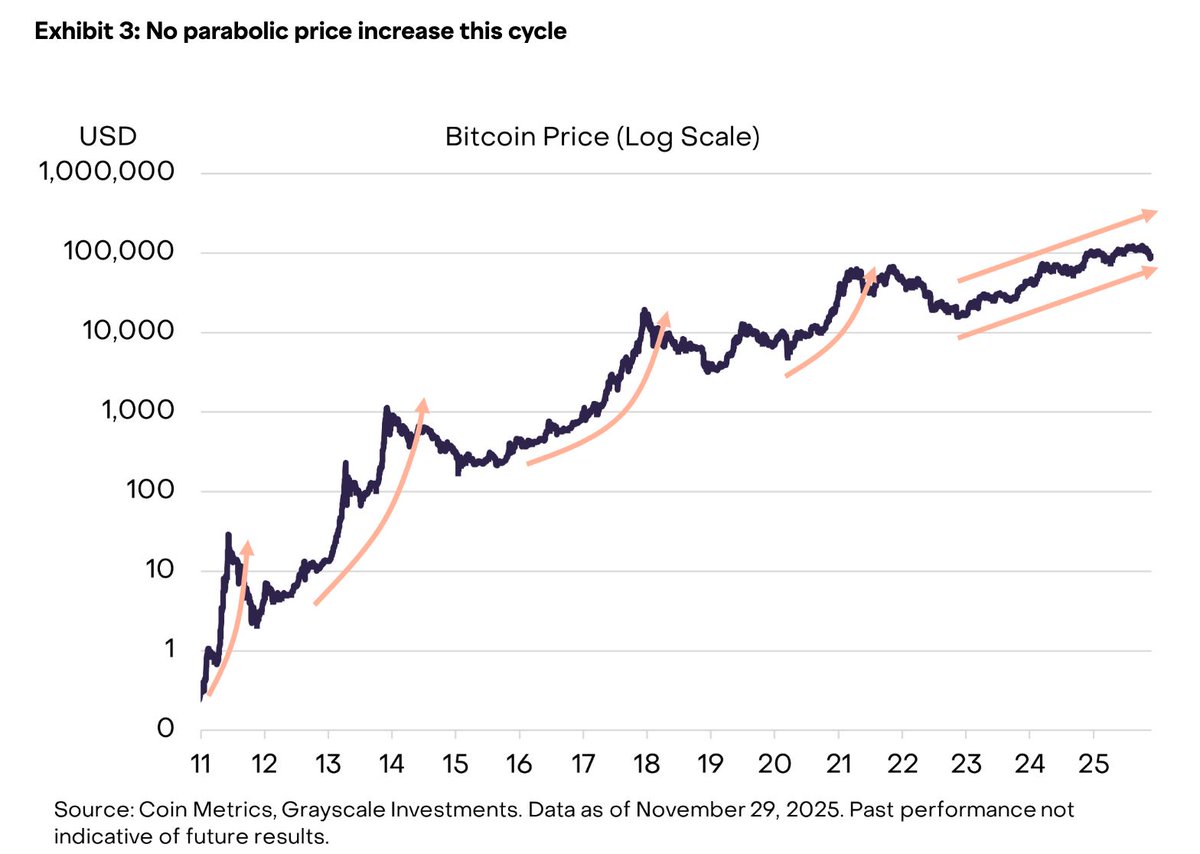
According to Grayscale, several major factors are weakening the traditional halving-anchored pattern. The first is the absence of the classic parabolic overshoot. Earlier cycles included steep vertical rallies into euphoric tops, followed by brutal corrections. The current environment shows none of that behavior. Instead, Bitcoin has been climbing at a steadier, controlled pace, reflecting a broader investor base and more efficient price discovery.
The second factor is the rise of exchange-traded products and digital-asset-treasury (DAT) companies. These vehicles create continuous inflows and adjust the supply–demand dynamics that historically fueled aggressive post-halving surges. Grayscale notes that ETF participation compresses volatility and stabilizes long-term trends, pushing Bitcoin toward a multi-year grind rather than a sharp boom.
A third pillar of their argument is the macro backdrop. With institutional adoption accelerating and Bitcoin increasingly behaving as a global liquidity proxy, the asset is gaining structural tailwinds that don’t align with a simple four-year reset rhythm.
What the Chart Shows
The chart included in the report highlights the sharp contrast between past exponential periods and the more measured slope of the current cycle. In previous eras, the price trajectory curved dramatically upward near cycle peaks, forming clear parabolic arcs. The current cycle, shown on a log scale, follows a rising channel instead, without the rapid vertical expansion that characterized earlier runs.
This lack of extreme upward curvature is central to Grayscale’s thesis: Bitcoin’s volatility profile is flattening, and the market may already be transitioning into the next phase of growth rather than preparing for a collapse or explosive blow-off top.
The Road Ahead
Grayscale projects that Bitcoin is positioned for new highs in 2026, emphasizing that the fundamental drivers are stronger and more diverse than in earlier cycles. With institutional capital entering through regulated channels and Bitcoin adoption reaching deeper into traditional finance, the report expects the asset to follow a structurally bullish trend rather than a halving-dependent pattern.
The takeaway is clear: the market landscape that once dictated Bitcoin’s rhythm is no longer the same. If Grayscale is correct, investors may need to adjust their expectations, because the next chapter of Bitcoin may not look anything like the last decade’s cycles.