

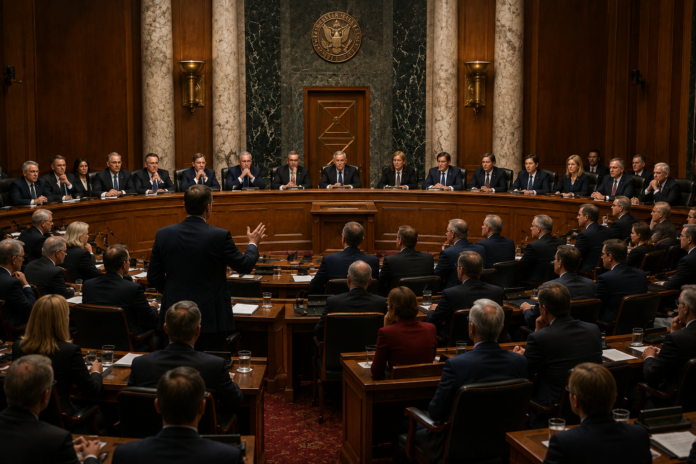

- The Senate Banking Committee voted 15-9 in favor of the CLARITY Act on Thursday after some Democrats switched camps to support the bill.
- The bill now heads to a vote on the Senate floor, although some Democrats have demanded an ethics provision before they support it in the next vote.
The long-awaited vote on the CLARITY Act in the Senate ended in victory for the crypto sector after the Senate Banking Committee voted 15-9 in favor of the bill. It now heads to the Senate floor, where it will need a simple majority of 51 votes to pass, or 60 votes if it faces a filibuster.
🚨JUST IN: The Clarity Act ADVANCES out of the Senate Banking Committee in a 15-9 bipartisan vote, with two Democrats voting in favor: @SenRubenGallego and @Sen_Alsobrooks.
Next stop: the full Senate.
— Eleanor Terrett (@EleanorTerrett) May 14, 2026
The Committee’s session was rife with debate on specific provisions and proposed amendments, most of which took a partisan divide.
Democrats insisted that the bill needed more work before it heads to the floor. Sen. Elizabeth Warren, the senior-most Democrat on the Committee, led the opposition. She insisted that the Senate should be addressing other pressing issues, “But instead of that, we’re spending our time working on a bill written by the crypto industry for the crypto industry.”
Her first proposed amendment was “to keep risky assets out of retirement accounts,” which failed 11-13. She then proposed expanding the bill to address crypto sanctions, citing Tornado Cash and how it was used by adversaries like North Korea. This proposal failed 11-13 as well.
Warren was unshaken and went on to propose a provision forcing banking regulators to release supervisory information. Specifically, she claimed this would allow Congress to assess how much they knew about the activities of Jeffrey Epstein, the convicted sex trafficker who was an early crypto investor. This also failed 11-13.
Ethics Provisions Fail
Then came the most contentious issue: the ethics provision amendment. Democrats want public officials barred from enriching themselves through crypto, citing Trump’s crypto activities.
In the debate, Senator Chris Van Hollen stated:
“This amendment is straightforward. It’s designed to prevent conflict of interest and self-dealing by the president or members of the House or the Senate. It also requires greater transparency. We have all seen the President and members of his family involved in corrupt crypto ventures and various crypto scams through World Liberty Financial.”
The accusations did not sit well with Republicans. Ohio’s Sen. Bernie Moreno shot back at Hollen for accusing Trump of engaging in crime. Additionally, the proposed provision dictated criminal penalties for convicted officials, which meant it was beyond the purview of the Banking Committee and should be handled by the Judiciary Committee, Moreno added.
This proposal failed 11-13. However, the Democrats made it clear that this amendment will have to be included, or they will vote against the bill once it lands on the Senate floor.
Ultimately, the CLARITY Act faced the Committee vote, where it passed 15-9. The victory was guaranteed by two Democrats who switched to support the bill: Ruben Gallego and Angela Alsobrooks. The two reiterated that their concerns on ethics and other provisions must be addressed first before they support the bill on the floor.
Crypto Welcomes CLARITY Act Passage
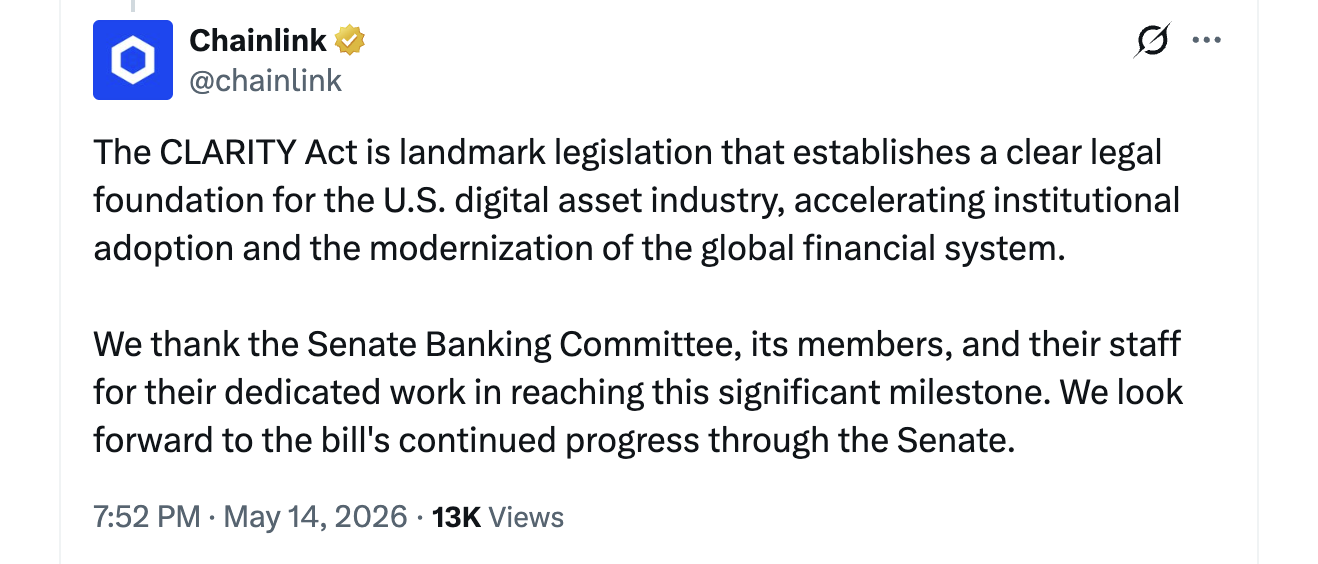
The crypto sector lauded the Banking Committee for passing the bill. Chainlink described the bill as “landmark legislation that establishes a clear legal foundation for the U.S. digital asset industry, accelerating institutional adoption and the modernization of the global financial system.”
Ondi Finance also described it as a “landmark moment for tokenization.” It added:
“The U.S. has led global finance for generations. If passed, this bill would help carry that leadership into the next evolution of markets, one defined by tokenization and digital assets.”
Anthony Noto, the CEO of SoFi, the US bank whose crypto activities have expanded massively in the past year, says passing the bill brings America closer to “a durable regulatory framework.”
Grayscale also hailed the vote as “an important milestone in the effort to modernize the regulatory framework for digital assets.”
Grayscale welcomes the Senate Banking Committee’s advancement of the Clarity Act, an important milestone in the effort to modernize the regulatory framework for digital assets.
For investors and market participants, clear market structure rules can help reduce uncertainty,…
— Grayscale (@Grayscale) May 14, 2026
Others that welcomed the vote included Solana, the Zebec Network, former White House AI and Crypto Czar David Sacks, Injective, Evernorth, and Tom Lee’s Bitmine.