




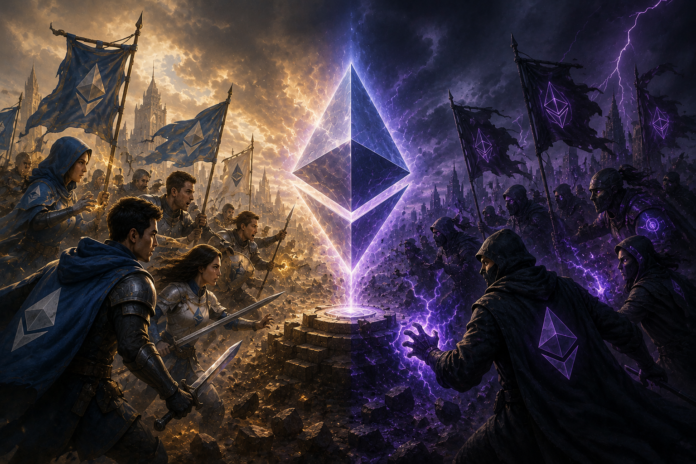

- Ethereum civil war is gaining steam, with Vitalik Buterin and the Ethereum Foundation on one side, and on the other, those opposed to their vision.
- Some have blasted Vitalik’s vision as “incompetent dictatorship,” while others accuse the Foundation of catering purely to a small cabal.
It has been a rocky year for Ethereum. ETH has lost a third of its value since the turn of the year as spot Ether ETFs bled $2.4 billion after five consecutive months of net outflows. DeFi dominance is down to 50%, while decentralized exchanges are on their worst run in two years.
However, the network’s biggest challenge this year has been over Ethereum’s leadership.
For over ten years, founder Vitalik Buterin has steered Ethereum as its de facto leader. He has used the Ethereum Foundation to implement this vision.
Over the past year, the Foundation has lost some of its biggest names and risks losing the community’s support as well. As we reported, some of the big names that have departed include Tim Beiko and Alex Stokes. Vitalik has defended the reshuffles and departures as natural for any institution, but some are seeing through this and voicing their concern.
Ethereum Community Questions Vitalik’s Leadership
One of the many who have questioned Vitalik and the Foundation is Justin Bons, the founder of European crypto fund CyberCapital. He recently claimed that the network has been in collapse for years due to several “disastrous” decisions at the top. He described Vitalik’s leadership as “incompetent dictatorship.”
Ethereum has been in decline for years
It has been one disastrous decision after another
From the failed "L2 scaling" roadmap to now openly stating ETH will not compete on speed…
ETH will continue to lose as it is run by an incompetent dictatorship; the result is mediocracy!
— Justin Bons (@Justin_Bons) May 27, 2026
One of the key issues he raises is the decision to focus on scaling L2s over the main network. Ethereum has been unable to scale like its rivals, such as Solana, but its leadership has pushed L2s as the ideal scaling solution. However, L2s “have a parasitic relationship with the L1,” and this is what will kill Ethereum, Bons says.
This challenge has been highlighted by many previously. With the EIP-4844 upgrade, Ethereum enabled L2s to execute transactions by default, cutting costs for L2s by over 90%. That meant the L1 became the settlement layer, but all the economic transactions are on L2s. Last year, daily network gas revenue fell to a peak of $6 million, down from previous peaks of $23 million.
Zak Cole, a veteran Ethereum contributor, joined the campaign against the Foundation recently. In a podcast hosted by Laura Shin, he stated:
“The Ethereum Foundation is completely out of touch. They’re funding hippos in Asia and doing a bunch of stuff nobody in the world gives a shit about other than Vitalik and his little cabal.”
Even those who defend the Foundation’s role and say it deserves credit for its contributions admit that it has handled some issues wrongly. One of these is Chris Boulos, the president of the company that built Aerodrome decentralized exchange, which runs on Base, an Ethereum L2 built by Coinbase.
He stated:
“The substantive critique, that direction has been unclear and wasteful and that the app layer has been a secondary concern, is fair. The EF has tried to be many things to many constituencies at once, which is not only difficult to execute on but takes focus away from perhaps more product-oriented players.”
However, according to Vitalik, the future of the network is to have the Foundation’s role reduce significantly. He views the entity as a single node with its defined purpose in a sea of nodes.



