





- DTCC has selected Stellar to offer tokenization infrastructure for the clearing giant’s $114 trillion in assets under custody.
- Stellar Development Foundation CEO Denelle Dixon says the network was “truly built for this moment.”
The Depository Trust & Clearing Corporation (DTCC), the world’s largest clearing and settlement company, has chosen Stellar to tokenize over $100 trillion in assets under its custody.
DTCC announced that it would enable the tokenization of assets held by the Depository Trust Company, its subsidiary for asset custody.
DTCC and the Stellar Development Foundation announced today plans to enable the tokenization of DTC‑custodied assets on the @StellarOrg network. This collaboration advances DTCC’s multi chain strategy and expands how traditional assets move across digital ecosystems.… pic.twitter.com/bdeX0JmDGY
— DTCC (@The_DTCC) May 27, 2026
Stellar becomes the second blockchain network to anchor DTCC’s tokenization. The first was Canton, the network designed by Wall Street for Wall Street, and which holds $203 billion in real-world assets (Ethereum is at a distant second with $18 billion).
Notably, DTCC has steered clear of Ethereum and its L2s. Neither Canton nor Stellar is natively compatible with Ethereum’s EVM. This is despite DTCC’s own private blockchain, Appchain, running on Ethereum infrastructure.
DTCC President Frank LaSalla commented:
“We are committed to expanding opportunities for market participants to utilize tokenized assets to access deeper liquidity, achieve greater efficiency and increase transparency on a public blockchain, while retaining the same investor protections and safeguards participants are used to today for traditionally held assets at DTC.”
He added that tokenization is enabling new levels of transaction and capital efficiency. It has also increased capital mobility, as tokens can move at the click of a button. Tokenization has also allowed Wall Street to extend trading hours beyond the traditional seven-hour, five-day workweek, with some platforms offering 24-5 trading and settlement.
Dixon: Stellar Was Truly Built For This
DTCC’s selection of Stellar is one of the biggest moments for the network. DTCC is the world’s largest financial institution and the backbone of the US capital markets. Last year, it processed $4.7 quadrillion in securities transactions. For context, that’s 150x the US GDP, which stands at $30 trillion, or $19 trillion in transaction volume settled daily.
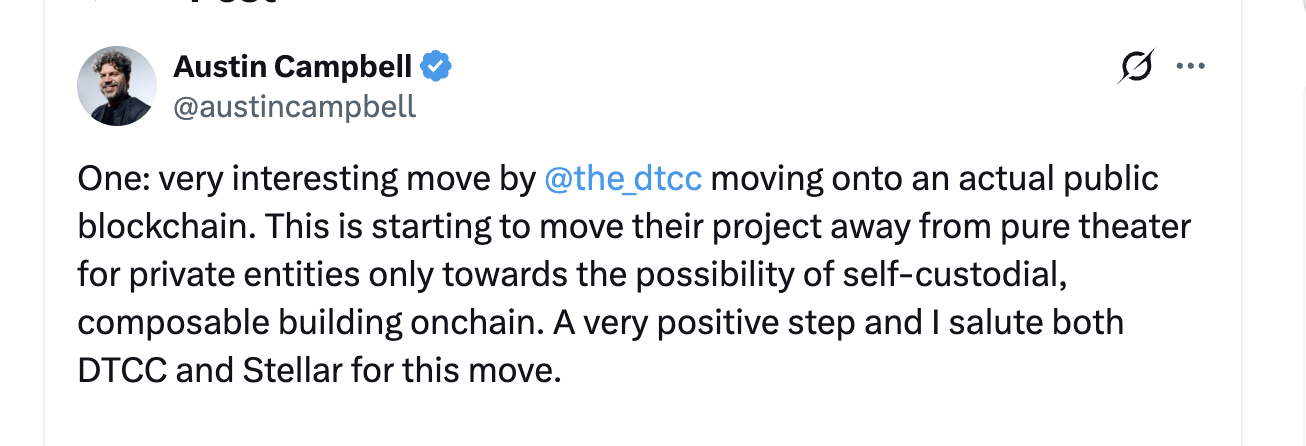
According to New York University Professor and ex-J.P Morgan’s Austin Campbell, DTCC is moving from “pure theater for private entities only towards the possibility of self-custodial, composable building onchain.”
He added that networks like Stellar and Avalanche are better suited to institutional adoption than some more popular networks, such as Ethereum and Solana.
“Institutions care more about open access + credible neutrality amongst each other + appropriate controls than maximum decentralization,” he notes.
One reason institutions prefer Stellar over Ethereum is how it handles tokens. On Stellar, tokens are native base-layer primitives; they are a built-in function, not separate programs built atop the network. On Ethereum, tokens are built on top of the network via smart contracts.
This is a vital requirement for DTCC. In December last year, the company received a no-action letter from the SEC in which the agency gave the green light for tokenization. In this letter, the watchdog required the DTCC to use chains that restrict token movement to registered wallets only. With a Stellar-like architecture, DTCC can force a wallet to transfer or burn tokens in cases of errors or fraud, which would not be possible with Ethereum.
Commenting on the announcement, Stellar Development Foundation’s Denelle Dixon said that DTCC chose the network because of its “proven compliance-minded architecture, open infrastructure and risk management capabilities.”
In a separate video, she said that her team has been building Stellar for over a decade for exactly these types of applications.
Today, @The_DTCC's tokenization service announced plans to connect with @StellarOrg starting H1 2027.
This integration will allow market participants to leverage traditional assets in a digital ecosystem for faster settlement, greater asset mobility, extended trading hours, cost… pic.twitter.com/lvBAbBhMIG
— Denelle Dixon (@DenelleDixon) May 27, 2026



