


- While Bitcoin continues to face an existential crisis from quantum computing, industry experts are only pushing angles that benefit their selfish interests.
- Those sounding the alarm the loudest are selling you the quantum-safe technology, while those dismissing it stand to lose the most from the upgrades.
Quantum computers will pose an existential threat to Bitcoin and most other blockchain networks, rendering current cryptographic techniques useless. This much is clear, and every expert agrees on. However, when this threat is likely to become a reality and what the industry should do about it remains contentious, with each party pushing selfish agendas to protect their business interests.
This divide most recently played out between Project Eleven, a quantum computing security firm targeting the crypto sector, and Mike Belshe, the CEO of BitGo, one of the industry’s largest custodians.
It started with Project Eleven publishing a report on the threat that quantum computing poses to blockchain networks. It claims that Q-Day, when a quantum computer powerful enough to break Bitcoin’s ECDSA encryption will land, is coming. It projects Q-Day might be as soon as 2030 in an optimistic timeline, or by 2042 in a pessimistic timeline.
Project Eleven says that its projection of 2030 is based on the fact that most leading researchers are now withholding details of their advancements to avoid aiding their rivals. As such, the trajectory for Q-Day could be “nothing at first, then all at once.”
The report says that a third of all Bitcoin, or 6.9 million BTC, is held in addresses vulnerable to quantum attacks. As ETHNews reported, other networks have assessed their vulnerability to quantum computing attacks, with researchers finding that 77 billion XRP is quantum-exposed.
With a quantum computer that’s powerful enough, an attacker could crack the Bitcoin encryption in nine minutes, Project Eleven stated, citing a previous Google report. With BTC transactions taking much longer to settle on average, attackers could theoretically be able to crack BTC transactions 41% of the time.
The Quantum Computing Debate Heats Up
The Project Eleven report was the latest to stir what has become a heated debate on quantum computing. Many welcomed the detailed breakdown in the 110-page report. However, the selfish interests that have dominated the quantum debate would soon emerge.
One of the most prominent leaders to call Project Eleven out was Mike Belshe, the CEO of BitGo, a leading crypto custodian with a 30% reported market share. BitGo held over $80 billion in crypto assets by the end of 2025 for over 5,000 institutional clients that include Fidelity’s Bitcoin and Solana ETFs.
Belshe claimed that Project Eleven wants to create panic about the quantum computing threat as its business model directly depends on this panic.
“You know what the report says without reading it,” he claimed.
The company who's business model depends on people freaking out about quantum computing is telling us to be freaked out about quantum computing.
You know what the report says without reading it. https://t.co/J3LqXmXd5J
— Mike Belshe (@mikebelshe) May 10, 2026
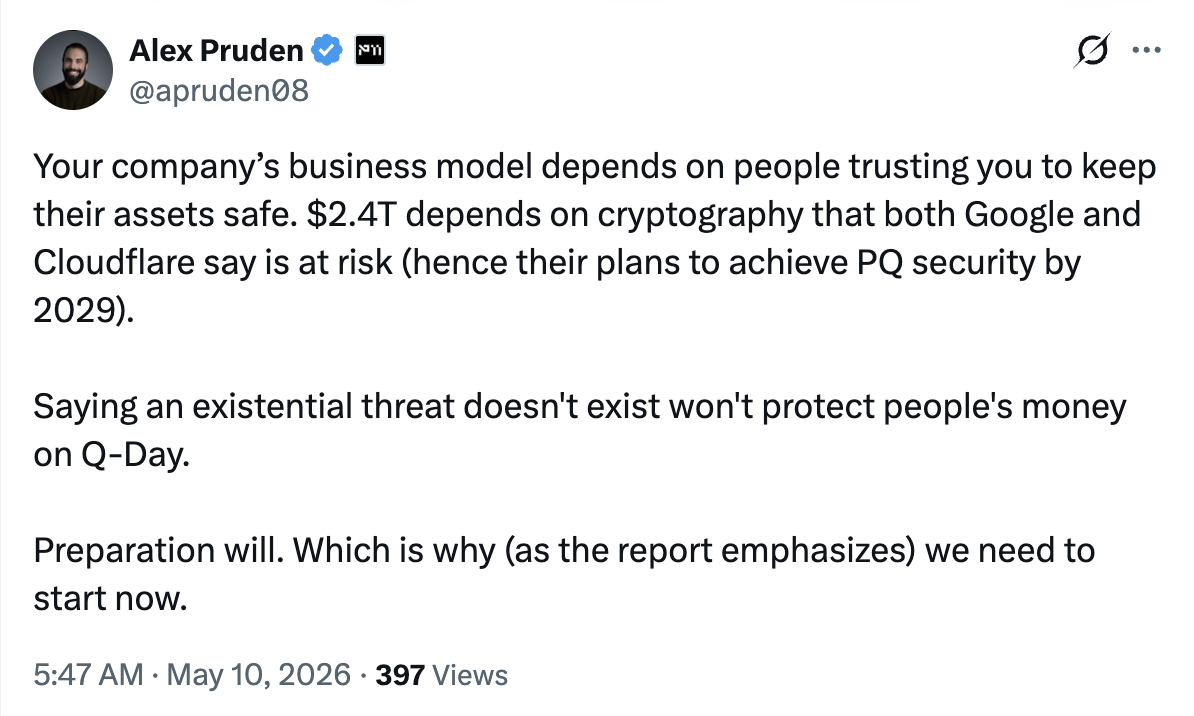
However, Belshe’s attack was not without its irony. His company holds BTC and other cryptos for some of the largest crypto holders, and if they believe BitGo cannot guarantee the security of these assets, its business model would collapse too.
This irony did not go unnoticed. Project Eleven CEO Alex Pruden called him out, pointing out that Belshe’s attack was purely an attempt at saving his company’s bottom line, not a genuine and balanced take.