






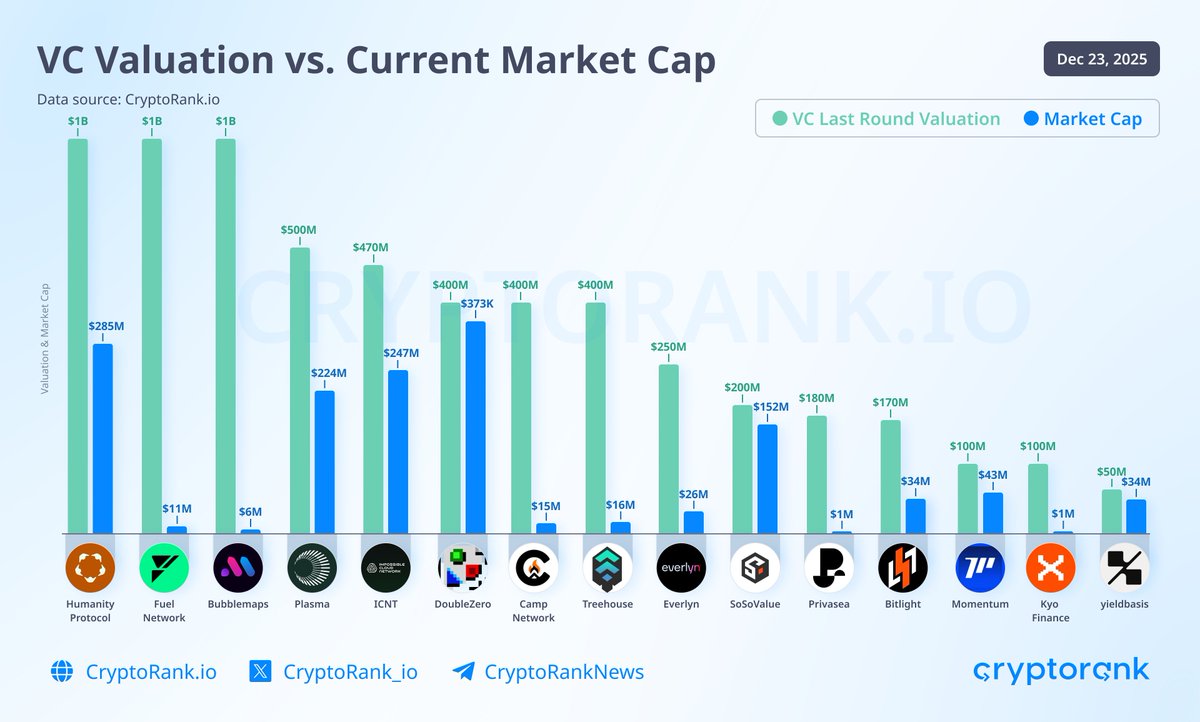
Crypto markets have a habit of exposing excess, especially after the excitement fades. The chart above captures one of the clearest examples of that cycle: the growing gap between venture capital valuations and current market caps.
This isn’t about one failed project or a single bad quarter. It’s about how narratives, liquidity, and optimism shape prices, and what happens when those forces unwind.
How hype inflates early valuations
During bull markets, capital moves fast and conviction moves faster. Venture funds compete for exposure to new narratives, often pricing projects based on future dominance rather than present adoption. As a result, last private funding rounds frequently assign $500 million to $1 billion valuations long before a token ever trades freely.
The chart shows exactly that dynamic. Many projects entered the public market with VC valuations several times higher than where their tokens trade today.
The reality check after sentiment shifts
Once momentum cools, the market begins doing what it always does: price discovery without optimism premiums.
Across the chart, blue bars (current market caps) sit far below green bars (last VC round valuations). In some cases, the difference is extreme, market caps are down 80–95% versus private valuations. This doesn’t necessarily mean the projects failed. It means the assumptions embedded in early pricing no longer hold.
Liquidity dries up, unlock schedules begin, and demand proves more selective than expected.
Why this gap matters to investors
This divergence highlights a critical lesson: VC pricing is not market pricing.
Private rounds often reflect:
- Narrative strength at the time
- Abundant liquidity
- Limited float and restricted access
Public markets reflect:
- Actual supply and demand
- Unlock pressure
- Risk appetite in real time
When sentiment fades, the market resets expectations brutally, and quickly.
The thinking part: risk isn’t linear
What this chart quietly reinforces is that crypto investing isn’t about being early alone. It’s about understanding where expectations already sit.
Projects don’t need to go to zero for returns to disappoint. If valuation assumptions were inflated from the start, even solid execution can struggle to justify early pricing.
That’s why experienced investors don’t anchor to VC numbers. They anchor to scenarios, downside, base case, and upside, and size risk accordingly.
Bottom line
Bull markets make aggressive valuations feel normal. Bear phases remind everyone what price discovery really looks like.
This chart isn’t bearish by itself, it’s educational. It shows why patience, context, and risk management matter far more than narratives when capital rotates and hype disappears.
In crypto, the market always gets the final vote.



