






- VeChain’s 2026 roadmap adds an agent indexer, a new explorer, SDK v3, and MCP On-Chain for AI-driven Web3 workflows.
- VET trades near $0.007238 after a 4.97% daily drop, while volume rises 10% to $22.59 million.
VeChain’s 2026 roadmap is advancing as the network expands its focus on AI workflows, developer infrastructure, and ecosystem analytics. Over the past few days, the project has outlined several updates tied to its new explorer, purpose-built indexer infrastructure, and TrustLayer stack for agentic Web3 activity.
VeChain plans to support hundreds of active dApps and thousands of autonomous agents operating simultaneously. That goal requires faster data access, stronger monitoring tools, and blockchain systems that can handle more automated activity.
VeChain said its new indexer infrastructure will support agents and dApps at scale. The indexer forms part of the same stack as MCP On-Chain, SDK v3, and the advanced explorer. These tools create a developer infrastructure layer built for a more active agentic ecosystem.
We are deploying purpose-built indexer infrastructure to support agents and dApps at scale.
Our 2026 roadmap includes purpose-built indexer infrastructure, deployed to support hundreds of active dApps and thousands of autonomous agents operating simultaneously.
This investment… pic.twitter.com/f23MxOru8S
— VeChain (@vechainofficial) May 13, 2026
Indexer infrastructure matters as AI agents need reliable blockchain data before they can act. These systems need fast access to transactions, activity records, balances, and on-chain events. VeChain is building that data layer to help applications run faster and respond more reliably.
VeChain’s TrustLayer stack is a foundation for blockchain-powered agent workflows. The network identified three main parts: the MPP protocol, fee delegation through VIP-191, and EVM parity. These features help developers build agent activity more easily.
MPP allows agents to batch transactions atomically. That means all parts of a transaction set execute together, or none of them execute.
Fee delegation through VIP-191 also means users and agents do not need to handle gas payments directly. Smart contracts can cover execution costs, while VTHO stays abstracted from real-world users.
VeChain Launches New Blockchain Explorer
VeChain is also rebuilding its blockchain explorer with a broader set of analytics tools. The upgraded explorer will include exchange data, DeFi TVL, staking TVL, VeBetter app-level activity, and other ecosystem metrics in one place.
This upgrade targets several user groups. Investors will get better visibility into ecosystem activity; researchers will receive cleaner on-chain data for analysis; and developers will access more advanced debugging and monitoring tools for production applications.
The network says its ecosystem processes more than 1 million sustainability proofs per week, holds 13 billion VET in staking, and supports more than 50 applications. VeChain aims to make network activity easier to read and verify by improving the presentation of this data.
Ultimately, VeChain’s 2026 roadmap links blockchain, AI, and tokenized activity into a unified operating model. AI supports reasoning, skills guide execution, and blockchain provides verifiable records.
Meanwhile, VET is moving inside a long-term falling channel on the weekly timeframe. The chart places VET near the lower support area, where buyers need to defend the structure to keep the recovery setup active. A stronger move from this support area could put the next upside targets at $0.015, $0.030, $0.055, $0.080, and $0.160 if buyers regain control.
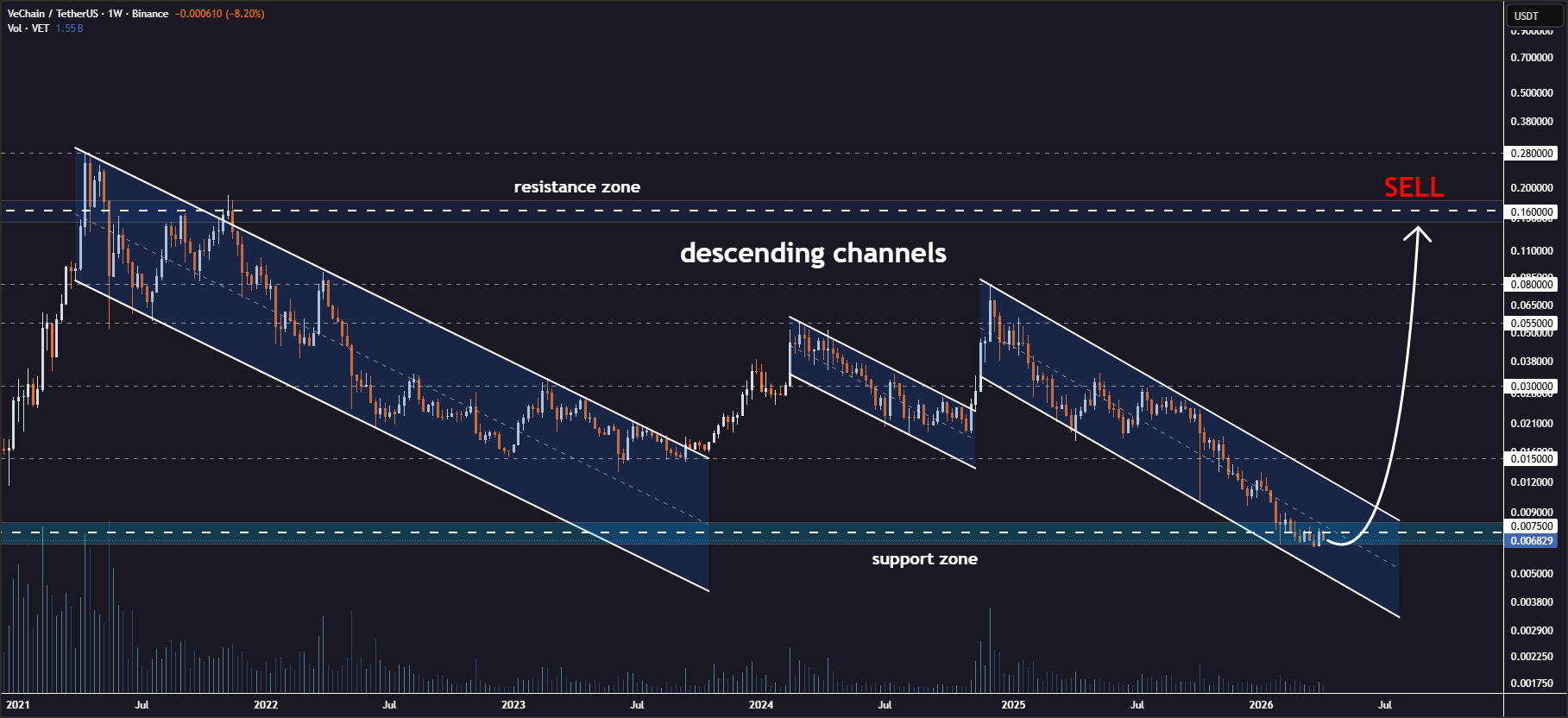
At press time, VET is trading near $0.007238 after falling 4.97% in the past 24 hours. Meanwhile, trading volume rose 10% to $22.59 million, pointing to heavier market activity as VET pulled back.



