

- Vitalik Buterin has suggested building index-tracking DeFi assets with options.
- The design could use slower oracles, though users would still need regular rebalancing to manage exposure and reduce slippage risk.
Ethereum co-founder Vitalik Buterin has proposed a new way to build index-tracking assets in decentralized finance, with options contracts replacing the debt-based model used across many DeFi systems.
In a Monday research post, Buterin said DeFi could reduce sudden liquidation risks by using options as the base layer for synthetic assets. His proposal focuses on assets that track price indexes, such as the U.S. dollar against ETH, inflation indexes, commodities, or other baskets.
Most synthetic assets and algorithmic stablecoins depend on collateralized debt positions. In that model, users lock crypto collateral and borrow against it. When prices move sharply, the system can force liquidations to protect the protocol from undercollateralized positions.
Vitalik Buterin argued that this structure creates a harsh failure point during market stress. A user may appear safe under normal conditions, then lose the position quickly once the collateral value falls below the required level. That process also depends on fast price feeds that update in real time.
Building index-tracking assets on top of options instead of debthttps://t.co/isSkr3901W
What if the use options as the base of defi, instead of CDPs and liquidations? So instead of extreme price movements creating a sharp and global "you get liquidated" effect, instead your…
— vitalik.eth (@VitalikButerin) June 1, 2026
His proposal takes a different path. Instead of creating debt that needs liquidation, the system would split 1 ETH into two option-like assets. One side would gain value when the chosen index stays within a defined range, while the other side would absorb the opposite exposure. At maturity, a slower oracle would settle the value.
Vitalik: Options Could Reduce Oracle Pressure
Vitalik said the key benefit comes from removing the need for instant liquidations. If no forced liquidation exists, the system does not need a real-time oracle to trigger urgent action. It can use slower oracles, similar to those used in prediction markets.
That change matters for DeFi security. Real-time oracles must react quickly, so they often depend on automated signals and a limited group of data providers. Therefore, attackers may try to manipulate short-term prices and push systems into wrong actions.
Slow oracles give the market more breathing room when price data looks wrong. Prediction markets can add another check before settlement, making it harder for bad data to move through the system unchecked.
However, the model still needs active management. Users would have to rebalance their synthetic assets when prices move close to major strike levels. Users may need to move from one strike price to another when market prices approach dangerous zones. Without that action, their exposure may slowly drift away from the target index.
Vitalik Buterin described this drift as smoother than liquidation. Instead of a sharp loss, the position moves away from the desired exposure in a gradual way. That creates a different risk profile, where users manage timing and slippage rather than face automatic liquidation.
He also noted that rebalancing costs remain an open issue. If users lose too much value through trading fees or poor liquidity, the model may struggle to compete with existing stablecoin and synthetic asset systems. Slippage-resistant market design would therefore play a major role in any practical version of the idea.
The proposal adds to a wider debate over how DeFi can handle leverage, collateral risk, oracle design, and market crashes without relying on forced liquidations.
Previously, Vitalik Buterin noted that AI-assisted formal verification could give Ethereum and the wider crypto industry a stronger security base. The method could help developers write more efficient code while reducing bugs that attackers often exploit in smart contracts.
Ethereum price action adds a market backdrop to the discussion. ETH has fallen below $2,000 and now trades under the 100-hour simple moving average. The altcoin recently touched $1,960 before buyers attempted a modest recovery. Resistance now sits near $2,000, with a stronger pivot around $2,020.
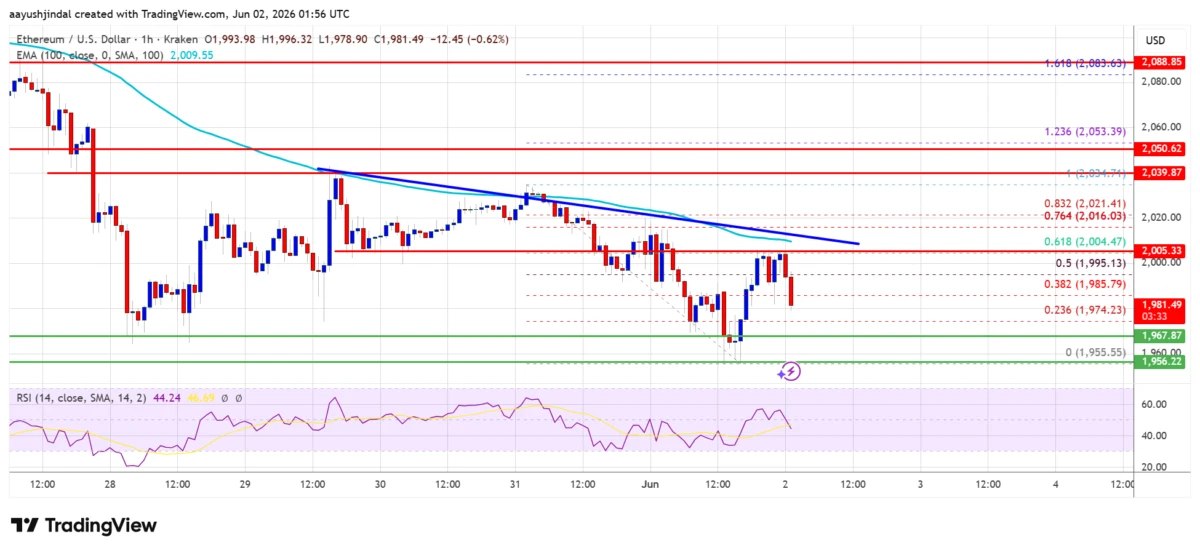
If the Ethereum price fails to reclaim $2,020, sellers may keep pressure on the market. Meanwhile, ETH support sits near $1,955, $1,920, and $1,880, with a deeper pullback risking $1,780 and a move above $2,050 opening room toward $2,120.