

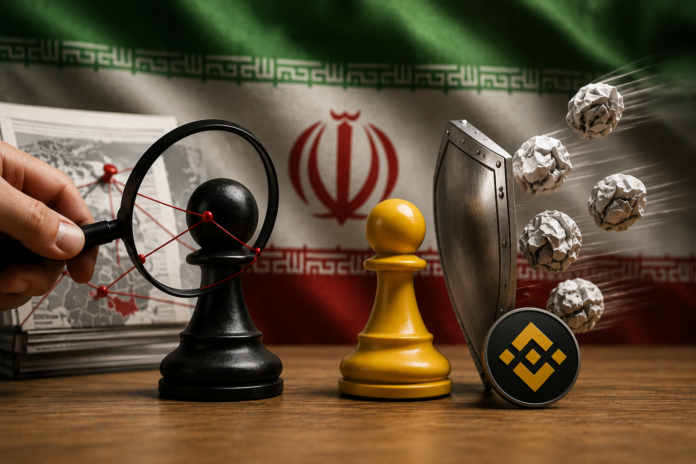

- The Wall Street Journal accused Binance of facilitating up to $850 million in crypto transactions for Iran via sanctioned entities and individuals.
- Binance has fought back, claiming WSJ continues to engage in a smear campaign against it.
Did Binance enable Iran to move $850 million worth of crypto through sanctioned entities without cracking down on these entities or reporting to authorities? This is the question at the heart of an escalating clash between the Wall Street Journal and the world’s largest crypto exchange.
This week, WSJ published an extensive exposé on Binance, accusing it of moving billions through its platform to fund the Iranian regime. The operation was allegedly run by Babak Zanjani, an Iranian who has become renowned for anti-sanction operations.
WSJ says Zanjani moved $850 million through Binance in accounts operated by himself, his sister, his romantic partner, and a director at his company. All these accounts were operated through the same device and were active as recently as last December.
The paper alleges that Binance’s internal compliance systems had flagged these accounts several times. Its own internal investigators were also aware of the accounts, and they described them as a money laundering network for Iran, compliance reports show. Still, Binance did nothing.
The Iranian operations extended beyond Zanjani. WSJ alleges that Iran’s central bank moved $107 million through the exchange, while another $260 million was moved in direct transactions by dozens of other sanctioned entities.
Binance Fires Back
Binance has refuted the accusations. In a statement to the outlet, a spokesperson for the company said it did not facilitate transactions for sanctioned entities and that it closed accounts for any user that was sanctioned.
On the funds that reportedly moved through its platform, the spokesperson said, “It appears the overwhelming majority of these transactions have nothing to do with the Binance platform.”
He added:
“Binance has zero tolerance for illicit activity on its platform, and since 2024, Binance has transformed and built a best-in-class compliance program. We work closely with law enforcement authorities around the world to detect, prevent, and combat financial crime.”
CEO Richard Teng also fired back, saying WSJ’s reporting “contained fundamental inaccuracies about the facts and Binance’s commitment to a strong compliance framework.”
He added that the transactions mentioned by the outlet were conducted before these entities were sanctioned. After WSJ reached out, the exchange reportedly investigated these issues. It then provided the facts of the issue to WSJ, but the outlet refused to publish them as they would prove Binance did not engage in any crime.
The WSJ’s reporting continues to contain fundamental inaccuracies about the facts and Binance’s commitment to a strong compliance framework.
Fact: Binance did not permit any transactions with sanctioned individuals on its platform, and transactions mentioned by WSJ happened…
— Richard Teng (@_RichardTeng) May 22, 2026
Binance and WSJ have a history of clashes, stretching back to a report by the outlet that accused the exchange of moving $1.7 billion for Iran. Binance denied the accusations and filed a lawsuit against the outlet.