


- Ripple CTO David Schwartz has clarified that XRP was not issued by Ripple and the XRP Ledger operates independently through a decentralized network of validators, countering centralization concerns.
- Meanwhile, analysts predict a potential bullish breakout, with XRP possibly reaching $6.29 if key resistance levels are surpassed.
In the ongoing debate surrounding the decentralization of blockchain networks, Ripple has found itself locked in a fierce battle and Ripple’s CTO was in the rescue. Ripple’s Chief Technology Officer David Schwartz, once again, has provided crucial insight, this time addressing lingering concerns over XRP’s centralization.
Garlinghouse is the CEO of Ripple, a company. XRP has no issuer — all the XRP that will ever exist was created when the ledger was created. Unlike most other blockchains, XRPL has no rivalrous features, so the ledger itself can't really do the initial distribution beyond letting…
— David 'JoelKatz' Schwartz (@JoelKatz) May 27, 2025
Meanwhile, on the other side, technical analysts are forecasting a bullish rally for Ripple’s native token that could see XRP soaring as high as $6.
Schwartz, one of the original architects of the XRP Ledger (XRPL), recently took to social media to dispel what he described as persistent misconceptions.
Central to his message was the reminder that Ripple, the private company he represents, did not issue XRP. All of the token’s supply was pre-mined at the inception of the XRP Ledger, unlike Ethereum or Solana where new tokens can be minted post-launch.
He further clarified that the XRP Ledger was designed without mechanisms to gradually distribute XRP over time, such as mining or staking rewards. Instead, anyone could acquire XRP at its genesis, making Ripple’s current holdings a matter of historical acquisition rather than centralized control.
Importantly, Schwartz emphasized that Ripple operates as just one participant in a wider ecosystem governed by a decentralized network of validators, many of whom are independent entities such as universities and exchanges.
Schwartz also challenged the crypto community to reconsider what decentralization really means. Instead of fixating on labels or token ownership, he urged users to reflect on the outcomes they desire: resistance to censorship, protection against single-party control, and overall system resilience. These, he argued, are the true metrics of decentralization.
XRP’s Bullish prediction
While Schwartz laid to rest doubts about XRP’s network structure, prominent crypto analyst Master Ananda delivered a bold technical forecast: XRP could reach as high as $6.29 in the coming months.
In a TradingView post published on May 27, Ananda noted XRP’s strong support at the $2.30 level and identified a bullish breakout from a falling wedge pattern, followed by the formation of a rising channel.
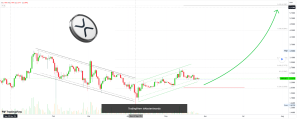
Using Fibonacci extension tools, Ananda pinpointed the 2.618 extension level at $6.29 as a likely target if the current momentum holds. He cautioned, however, that the opportunity to enter at lower prices could disappear quickly as market interest surges.
Supporting Ananda’s outlook, fellow market watcher Egrag Crypto highlighted key resistance levels at $2.61 and $2.65. A breakout past these points could trigger a rapid push toward $3.10 and eventually challenge the “golden resistance zone” at $3.39.
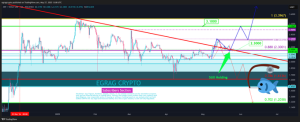
As of press time, XRP trades at $2.34, after surging 0.48% in the past 24 hours maintaining steady gains and building bullish sentiment. If the token breaks decisively above the $2.50 resistance, it may kickstart a parabolic move, potentially validating the ambitious $6 forecast.
With renewed confidence in XRP’s decentralized foundations and a bullish technical setup, the stage appears set for XRP to make headlines in the months ahead.