





New on-chain data shows that Bitcoin remains the primary entry point into the crypto market, capturing over $1.2 trillion in fiat inflows over the last year.
The chart, covering the period from July 2024 to June 2025, highlights how capital entering the digital asset space continues to concentrate first and foremost in Bitcoin before spreading elsewhere.
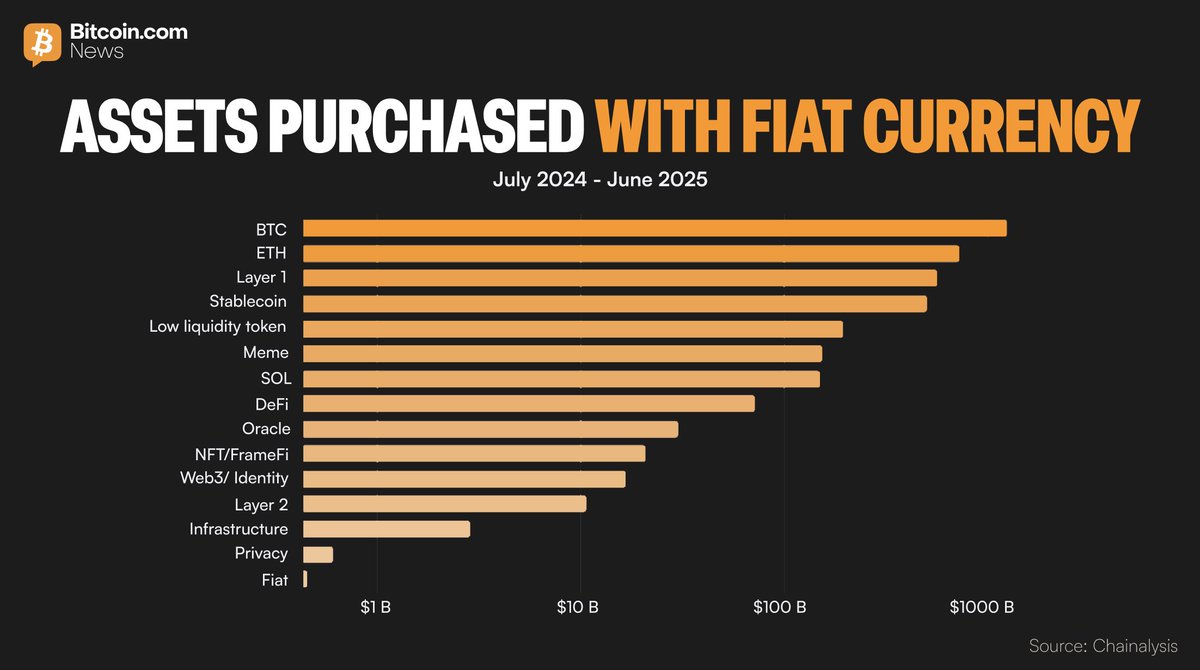
By comparison, Ethereum attracted roughly $724 billion in fiat inflows during the same period. While still substantial, that figure trails Bitcoin by a wide margin, reinforcing Bitcoin’s role as the default starting asset for new and returning investors alike.
Beyond the top two, the chart shows a clear drop-off. Other Layer 1 blockchains ranked third with approximately $564 billion, followed closely by stablecoins at around $497 billion. This positioning is notable: despite their importance for trading and settlement, stablecoins are still not the first destination for fiat capital entering crypto.
Instead, they appear more often as secondary instruments used after initial exposure is gained through Bitcoin or Ethereum.
Further down the list, categories such as low-liquidity tokens, meme coins, Solana-based assets, DeFi, and oracle tokens attracted progressively smaller shares of fiat inflows.
This distribution illustrates a familiar pattern in crypto market cycles: capital tends to enter through the most liquid, established assets before rotating into higher-risk or more specialized sectors.
The takeaway from the chart is structural rather than cyclical. Even as the crypto market broadens and diversifies, Bitcoin continues to function as the market’s main on-ramp, absorbing the largest share of fiat demand. Other sectors may outperform during certain phases, but when fresh capital enters the ecosystem, it overwhelmingly starts with Bitcoin.



