




- The European Central Bank has pushed back against policy proposals to lower the requirements for euro-backed stablecoins.
- Euro stablecoins account for 0.3% of the global $324 billion market, but Europeans accounted for 38% of all stablecoin transactions in Q4 last year.
Europe is in no rush to catch up with the US in the stablecoin arena, with the region’s top bank rebuffing proposals to lower barriers for euro stablecoin issuers.
The European Central Bank was presented with a policy proposal by Brussels-based think tank Bruegel to lower liquidity requirements for stablecoin issuers. The think tank also proposed giving these issuers access to ECB funding, similar to how commercial banks count on the ECB as the lender of last resort. This is the only way to counter the domination of US dollar-pegged stablecoins, Bruegel said.
However, according to sources at the event, which also involved European finance ministers, the ECB rebuffed the proposal.
Christine Lagarde, the ECB President, was among the biggest critics of the proposal. She says this would threaten bank deposits and disrupt one of the key sectors that support the European economy. It would also limit her organization’s ability to engineer interest rates, the sources told Reuters.
Stablecoin issuers receive fiat currencies from their users and issue them with a digital equivalent, usually denominated in USD. They then use the fiat currencies to purchase bonds and other liquid assets, from which they generate yield.
Europe Lags Behind in Yet Another Field
Despite being one of the wealthiest and most influential regions, Europe has lagged behind in innovation for decades. Its role has largely been limited to regulating, while North America and Asia invent. This includes the current AI wave, where American and Chinese companies are setting the pace, while Europe focuses on regulatory frameworks such as the EU AI Act.
Stablecoins are one of the fields where Europe has lagged the most. Data shows that US dollar-pegged stablecoins account for over 99% of the market, now valued at $324.2 billion. The largest euro stablecoin is Circle’s EURC, with a market cap of $438 million, but it does not rank in the top 20.
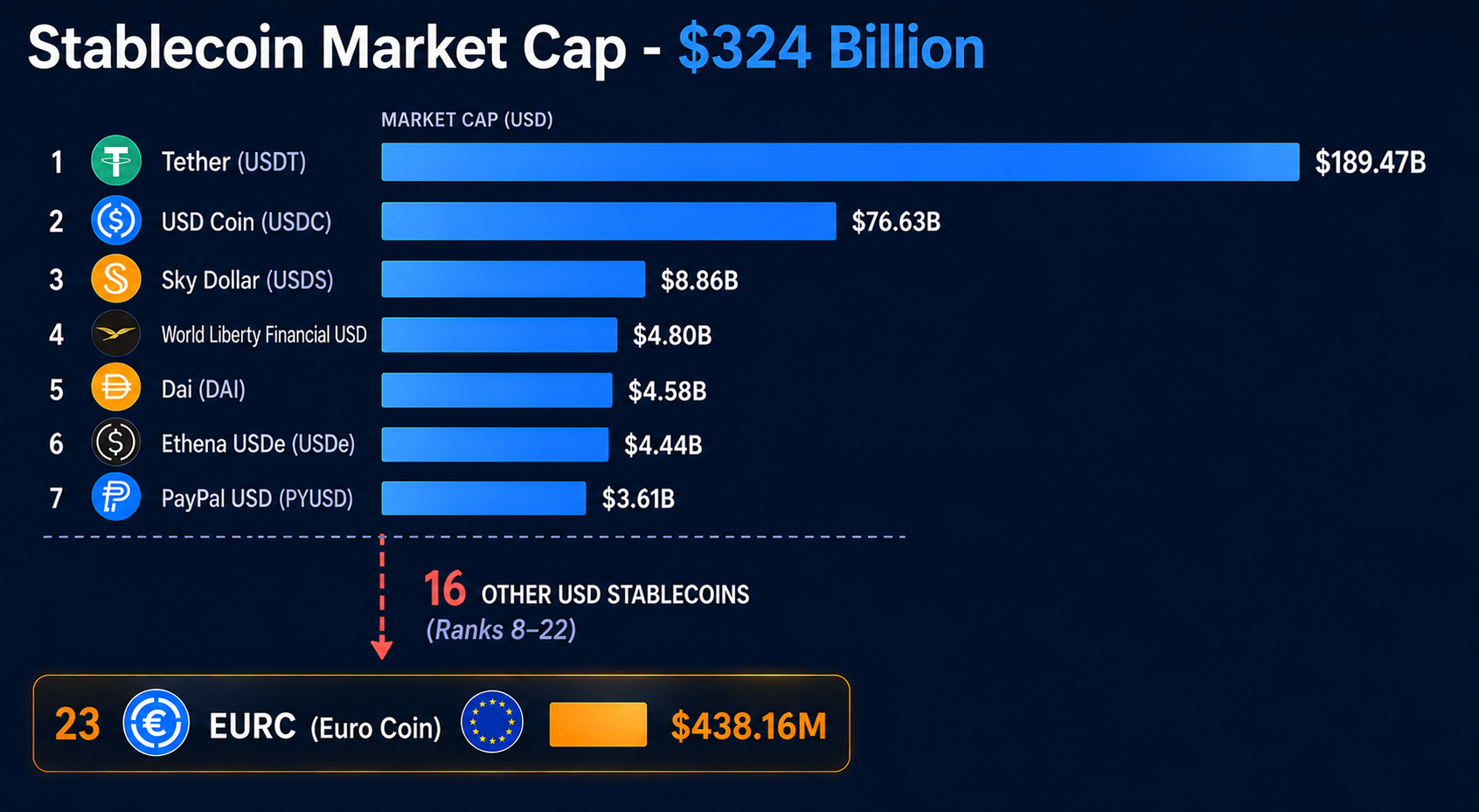
This is unlikely to change any time soon. Even when the think tank voiced concerns about Europe ceding market share to the US, the ECB reportedly dismissed concerns about digital dollarization.
But while the euro only accounts for less than 1% in stablecoin share, European consumers accounted for 38% of all stablecoin transactions in Q4 last year.
However, while the ECB denounces stablecoins, European commercial banks are betting big on these tokens. This week, 37 banks backed Qivalis, a Dutch-based euro stablecoin project that will be integrated into the banking rails. Qivalis has yet to launch its stablecoin, but it already has the backing of the largest lenders in Europe, including BNP Paribas, ING, Intesa Sanpaolo, and ABN Amro.



