




- Analysts say IOTA’s price has not fully caught up with its recent progress across Rebased, TWIN, ADAPT, and Starfish.
- Kenya, Morocco, and Nigeria now implement ADAPT, giving IOTA exposure to digital identity, trade data, and payment interoperability.
IOTA is gaining fresh market attention as its real-world infrastructure expands while the token trades near deeply compressed levels. Analysts tracking the project say the market has not fully priced in IOTA Rebased, staking, validators, Move-based programmability, Starfish, TWIN, and early national-level trade deployments.
IOTA was trading near $0.06239 in recent market data, up over 16% in the last 24 hours. The token recently tested the $0.0547 area after a long decline from its 2025 highs. That zone now acts as a key base for traders watching whether buyers can defend the lower range.
The next recovery levels remain clear. IOTA needs to regain stronger momentum above the short-term range before testing $0.078 to $0.081, a resistance area traders now view as important. A move above that zone could shift attention toward the yearly high region, while failure may keep the token locked in consolidation, one analyst says.
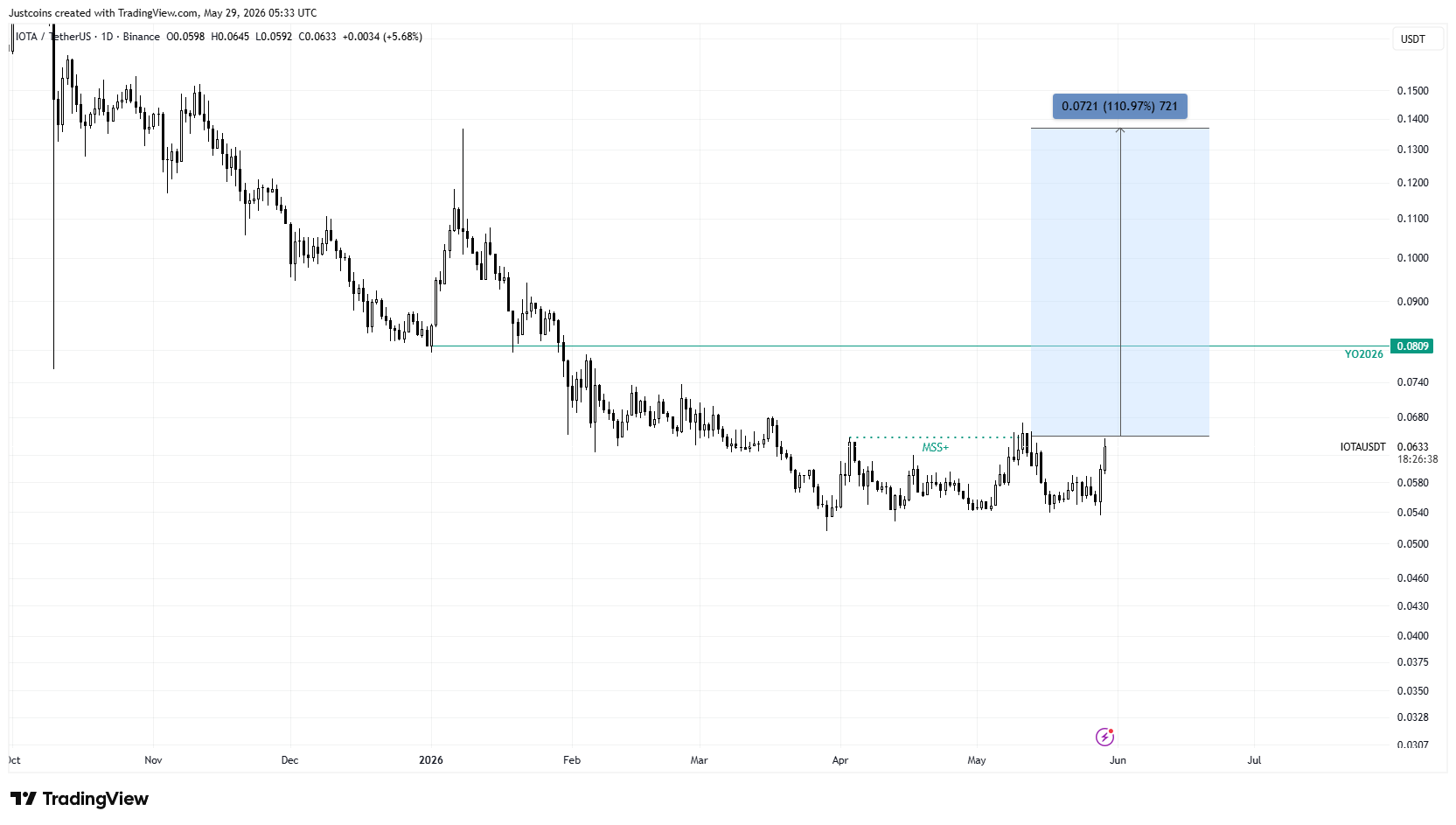
Despite the latest rally, IOTA’s price has not yet confirmed a broad trend reversal, even as the project continues to deliver infrastructure upgrades and real-world pilots.
IOTA Rebased sits at the center of that discussion. The upgrade brought staking, validators, and stronger programmability to the network. Its average APY was recently shown at 10.58%, keeping yield above 10% one year after launch. That gives holders a direct role in network security and supports the shift toward a more mature public network.
Real-World Infrastructure Strengthens IOTA’s Case
The underpricing argument goes beyond short-term price action. Kenya, Morocco, and Nigeria are the first countries implementing ADAPT, the Africa Digital Access and Public Infrastructure for Trade initiative. The AfCFTA Secretariat leads the programme with the Tony Blair Institute for Global Change, the World Economic Forum, and the IOTA Foundation.
ADAPT’s first rollout targets digital identity, cross-border data sharing, and smoother payment links. The plan tackles paper documents, slow payments, disconnected systems, and weak data sharing.
TWIN provides the open digital trade infrastructure behind ADAPT. It supports verified trade documents, product traceability, digital identity, compliance workflows, and trusted data exchange. For IOTA, that places the network inside supply chains, customs, payments, real-world assets, trade finance, and machine-economy use cases.
This is why some analysts describe IOTA as one of the more asymmetric assets in the current crypto market. Their view rests on infrastructure, not hype. IOTA has spent years building tools for digital trust, while its current valuation still reflects an older market perception of the project.
The launch of Starfish on mainnet through Protocol Version 24 adds another layer to that case. Starfish improves IOTA’s consensus design and supports the network’s push toward stronger validator coordination. Along with Move VM and Rebased, it helps IOTA operate more like a programmable infrastructure network than a legacy altcoin.
Community analysts also argue that IOTA’s next phase requires a smaller role for the IOTA Foundation over time. In that view, the network becomes stronger as validators, builders, institutions, and applications take more direct responsibility. TWIN could then grow as an enterprise layer using IOTA as a neutral infrastructure.




