


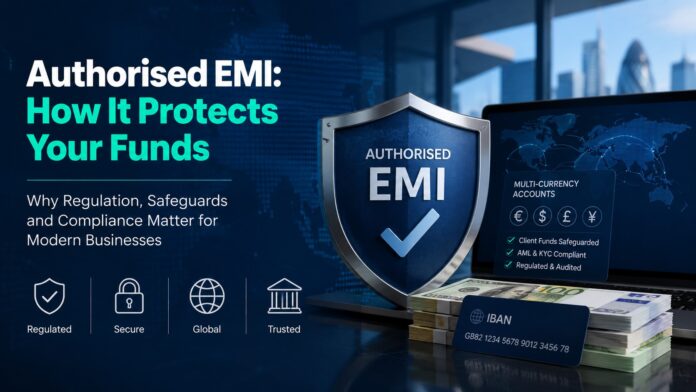

For modern businesses, especially those operating internationally, the way they hold and move money is as important as the products they sell. Many companies now use electronic money institutions (EMIs) to manage payments, multi‑currency accounts, and cross‑border transfers. But not all EMIs are created equal. Understanding what an authorised EMI is—and why it matters for your funds—can make a real difference in how safe and efficient your financial operations are.
At enter.global, we help businesses choose the right financial partners, including EMIs that are fully compliant and secure enough to support their growth and global operations.
What Is an Authorised EMI?
An Electronic Money Institution (EMI) is a specialised financial firm that issues electronic money and provides payment services. Unlike traditional banks, EMIs focus on digital payments, currency management, and rapid onboarding rather than lending or full‑scale banking services. They can offer tools such as multi‑currency wallets, IBANs, virtual account numbers, and integration with payment gateways.
An authorised EMI is not just any fintech platform—it is a firm that has been licensed and regulated by a financial authority (such as the Financial Conduct Authority in the UK, or the Central Bank of a given EU state). This means the institution must meet strict requirements around capital adequacy, internal controls, anti‑money‑laundering (AML) checks, and customer‑funds protection.
For businesses, that authorisation is a sign that the EMI is operating under a clear regulatory framework, not as a loosely regulated startup.
How EMIs Protect Your Funds
One of the most important reasons to care about EMI authorisation is how it affects the safety of your money. Regulated EMIs are required to:
- Safeguard client funds. Money held by customers is typically kept in segregated accounts at licensed banks. This means your business funds are kept separate from the EMI’s own capital and cannot be used to cover the institution’s losses.
- Comply with strict liquidity and capital rules. EMIs must maintain sufficient reserves and capital buffers to ensure they can meet their obligations to clients.
- Follow robust AML and KYC procedures. Every business that opens an account must be properly verified, reducing the risk of fraud or misuse of the platform.
- Report to regulators and submit to regular audits. This oversight helps ensure that the EMI’s operations remain transparent and compliant over time.
In practical terms, this means your funds in an authorised EMI are not simply sitting in a generic company account. They are managed under rules designed to protect you as the client, which is especially important for SMEs and international businesses that rely heavily on digital payment infrastructure.
Why EMI Authorisation Matters for International Businesses
For UK or international companies that operate across borders, EMI structure is often central to how they receive, hold, and pay in different currencies. Authorised EMIs can:
- Hold e‑money in multiple currencies, allowing businesses to receive and keep funds in the currencies they need.
- Offer SEPA, SWIFT, and other payment rails so companies can send and receive international transfers efficiently.
- Provide API‑driven environments that integrate with accounting software, e‑commerce platforms, and payment gateways.
However, if the EMI is not properly authorised, these benefits come with higher risk. An unregulated or lightly regulated provider might not have the same safeguards, reporting standards, or liquidity requirements. In the event of financial difficulty or regulatory scrutiny, client funds could be exposed.
At enter.global, we help businesses identify EMIs that are fully authorised and regulated, so that their international payment flows are both efficient and secure.
Authorised EMI vs. Traditional Bank: A Practical Difference
EMIs and banks are often compared, but they serve different roles. A traditional bank offers full‑scale banking services, including lending, overdrafts, and deposit‑taking. An authorised EMI, by contrast, specialises in electronic money and payments, with a strong focus on speed, digital infrastructure, and cross‑border rails.
From a security perspective, both types of institutions are regulated, but under different frameworks. Banks are usually supervised under banking‑capital rules, while EMIs are supervised under electronic‑money or payment‑services frameworks. For businesses that mainly need to move money quickly and safely, rather than borrow capital, an authorised EMI can be a more flexible and cost‑effective solution.
The key similarity is that both should offer protected client‑funds treatment—your money is not mixed with the institution’s assets and is managed under strict rules.
How Authorisation Affects Compliance and Trust
For businesses that work with clients, suppliers, and payment providers, the reputation and compliance level of their financial partners matter. Using an authorised EMI signals that:
- The institution is subject to ongoing regulatory review and can be held accountable.
- Transactions are processed under clear AML and KYC standards, reducing the risk of blacklisting, holds, or compliance rejections.
- Customers and partners can trust that the underlying payment infrastructure is legally sound and transparent.
This is especially important for industries that face higher scrutiny, such as fintech, iGaming, crypto‑related services, and cross‑border e‑commerce. At enter.global, we help businesses structure their financial relationships so that every EMI partner they use is fully compliant and authorised, reducing regulatory risk and improving long‑term reliability.
Why EMI Choice Impacts Your Cash‑Flow Strategy
Beyond safety and compliance, the choice of EMI also shapes how smoothly your business can manage cash flow. Authorised EMIs typically offer:
- Faster onboarding and account opening, often fully online.
- Lower or transparent fees for transfers and currency conversions.
- Real‑time reporting and dashboards that integrate with your accounting systems.
For companies that make frequent international payments, these features can significantly reduce administrative overhead and improve financial visibility. When combined with a well‑structured multi‑currency setup, authorised EMIs can help businesses reduce unnecessary FX conversions and timing mismatches.
At enter.global, we help companies design payment architectures that use authorised EMIs where they add the most value—whether as a primary business account, a multi‑currency wallet, or a dedicated cross‑border‑payments layer.
How enter.global Supports Your EMI Strategy
Choosing an EMI is not just a “technical” decision—it is a strategic one that affects your security, compliance, and operational efficiency. enter.global works with businesses to:
- Identify authorised and regulated EMIs that match their jurisdiction, industry, and risk profile.
- Evaluate client‑funds protection, FX pricing, and payment‑rail options for each provider.
- Implement structures that keep client funds segregated and properly safeguarded.
- Integrate EMIs into a broader banking and compliance framework that supports growth and international expansion.
For UK and international companies that rely on digital money infrastructure, an authorised EMI is not just a convenient tool—it is a key component of a secure, compliant, and scalable financial strategy.



