


- Ronin, the blockchain network that was once hacked for $625 million, is plugging back into Ethereum after five years as an independent sidechain.
- The move will cause a 10-hour outage on May 12, with token inflation dropping 95% while marketplace fees surge 150%.
Ronin, a standalone blockchain network that was once the site for the largest hacks in crypto history, is merging into an Ethereum Layer 2.
Ronin first announced its plan to connect to Ethereum last August. Sky Mavis, the company behind the blockchain and the Axie Infinity gaming universe, said that it had launched Ronin back when Ethereum could not scale. Ethereum had advanced in its scaling since, and it was time for Ronin to reconnect.
Nine months later, the move is set to take place on Tuesday, May 12. The migration will be initiated via a hard fork, expected at block 55,577,490, which the network projects will be around 15:16 UTC (17:16 Central European Time).
In its announcement, Ronin stated that the migration will cause an outage that it expects to last at least 10 hours, during which all transfers, swaps and smart contracts will be temporarily suspended. Games that run on Ronin will also not offer any on-chain functionalities during the downtime. Once the migration is complete, all transactions are expected to resume immediately.
🛠️ Ronin L2 Migration – Scheduled Network Downtime
As part of the upcoming Ronin L2 migration, the network will experience approximately 10 hours of scheduled downtime.
During this downtime window, all network transactions [including transfers, swaps, and smart contract… pic.twitter.com/QvbRvZBqa7
— Ronin Shield (@ronin_shield) May 11, 2026
The network commented that it was the right time to “plug back into the mothership.” It added:
“Four years ago, we launched Ronin because Axie Infinity needed a faster and more efficient network. It worked. Axie Infinity onboarded millions of gamers to crypto, and Pixels proved that it was possible to do it again.”
Ronin’s Structural Changes: Security, Tokenomics, Staking
While it has described the move as “plugging back to Ethereum,” Ronin was never really an Ethereum L2. Rather, it launched in 2021 as a standalone sidechain linked to Ethereum. Assets could move easily between the two chains through a bridge, but Ronin had its own consensus, validators, tokenomics, and security model.
It was this bridging mechanism that cost the network $625 million in 2022 in what was the largest crypto hack at the time (Bybit has since taken over this unenviable title). It remains the largest bridge exploit and DeFi hack to date.
Ronin now migrates to the OP Stack, which is used by L2s like Base and Optimism, and will rely on EigenDA to fetch data. It claims this will improve transaction speed by 12x.
There’s a huge change coming to @Ronin_Network 👀
Ronin is reconnecting with Ethereum and becoming a Layer 2, but this update is much bigger than most people imagine.
Lower inflation for $RON, new rewards for builders through Proof of Distribution, major ecosystem changes, and… pic.twitter.com/m5YEX3ErCR
— Brisa 🎀 | KIND (@brisa_bit) May 9, 2026
One of the most significant changes will be in security, which Ronin has been seeking to tighten since the hack. As a Layer 2, it will no longer need to depend on its own validators and will tap into Ethereum’s vast network of validators.
The network also revealed that it would transition from passive staking to a hybrid proof of distribution model. Under this model, validators will not earn a reward just for operating a node; they must contribute actively to network activity.
The tokenomics also change. The annual RON token inflation will drop 95% annually from 20% to 1%. The marketplace fees will hike from 0.5% to 1.25%.
For the users, nothing will change. All the assets will also migrate automatically, and the tokens will retain their value and utility.
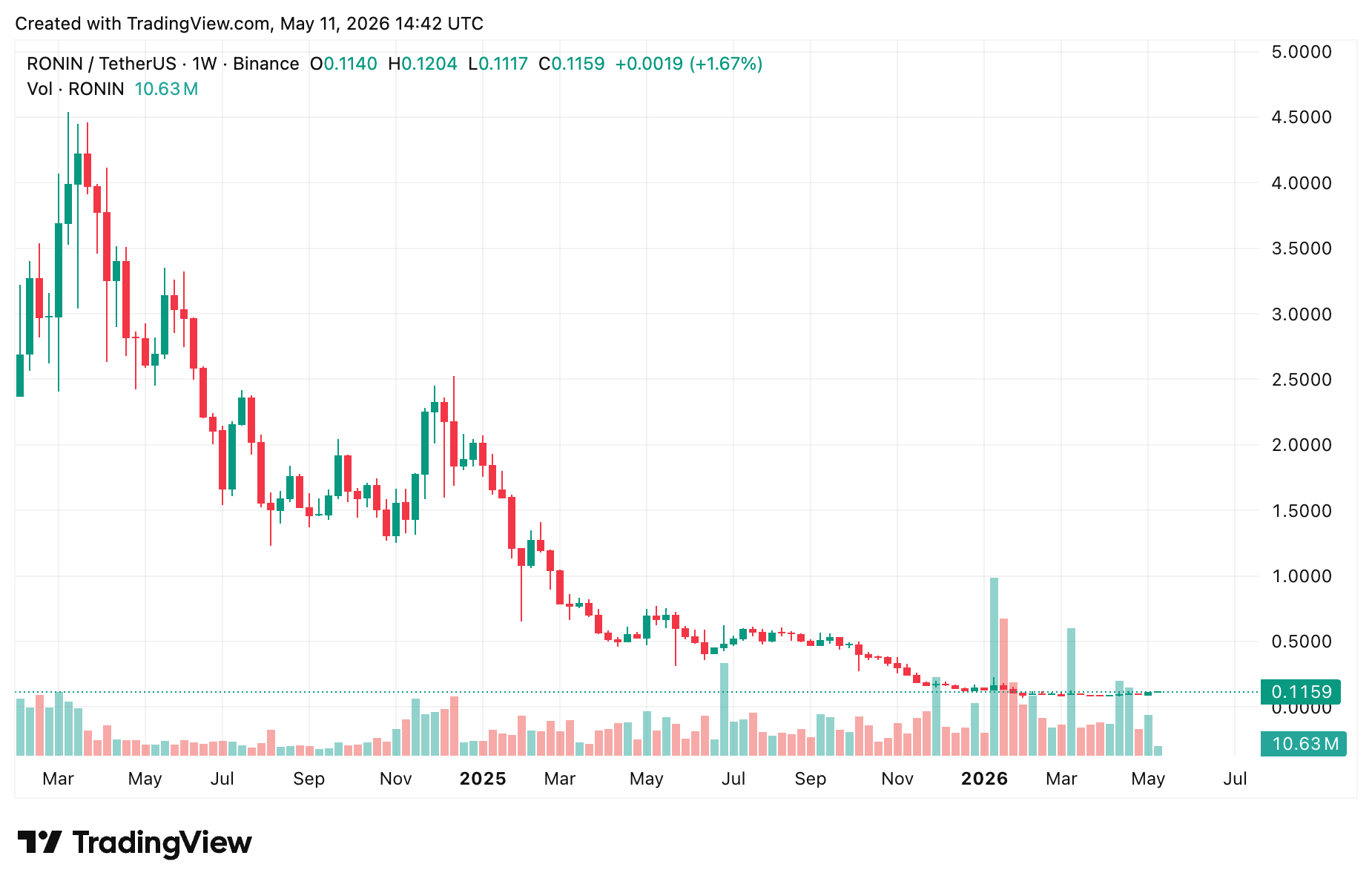
The migration has triggered a 20.6% rise in RON value to $0.1156. However, the token is still trading 97.4% from its all-time high of $4.45, which it hit in March 2024.