

SWIFT and XRp have been great rivals especially when it comes to cross-border payment methods. Interstingly, Ripple CEO Brad Garlinghouse revealed that the company aims to replace SWIFT’s liquidity layer, not just its messaging system.
Now, SWIFT’s Chief Innovation Officer, Tom Zschach has taken a shot at XRP which has sparked a heated debate. The Exec dismissed claims that Ripple and its native token have proven thier resiilience by surviving legal challenges.
This saga started with a post on LinkedIn after Zschach stressed that true strength in finance is built on trust and shared governance, and NOT SIMPLY WINNING A LAWSUIT.
According to Zschach, every transformative shift in financial history has been rooted in trust rather than technology alone. While technology may initiate change, he argued, adoption only happens once compliance, security, and enforceability are established.
Citing past examples such as stablecoins and decentralized finance (DeFi), Zschach noted that innovations often stall when they lack regulatory clarity and institutional trust.
Still, the executive acknowledged that public blockchains have grown too significant to ignore in 2025. From tokenized government bonds to blockchain-based financial guarantees and instant cross-border payments, Zschach recognized their emerging real-world utility.
However, he emphasized that blockchains by themselves cannot provide the safeguards institutions require. Legal protections and neutral governance models, he said, are essential for widespread adoption.
Ripple Advocates Push Back
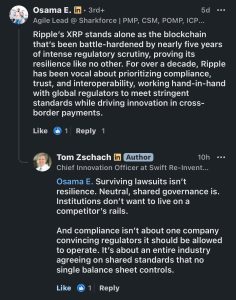
Not everyone agrees with Zschach’s assessment. Osama E., Agile Lead at Sharkforce Consulting, countered that the XRP Ledger (XRPL) is among the most thoroughly tested blockchains in existence.
He highlighted Ripple’s focus on compliance and global regulatory engagement, calling XRP “battle-hardened” after nearly five years of intense legal scrutiny.
According to Osama, Ripple’s decade-long work on interoperability, alongside partnerships with regulators worldwide, demonstrates its readiness for institutional use. He argued that Ripple’s legal survival has set crucial precedents for the broader industry, showing that blockchain companies can withstand regulatory pressure while continuing to expand globally.
“Surviving a Lawsuit Is No Big Deal”
Zschach, however, dismissed the notion that legal battles equate to resilience. “Surviving a lawsuit is no big deal,” he argued, adding that institutions will not rely on infrastructure controlled by a single company. For him, real compliance and resilience come only from open standards and governance structures that are not dominated by any one entity.
Zschach’s comments quickly stirred reactions from the XRP community, with many interpreting them as yet another attempt by traditional finance to downplay Ripple’s progress.
The longstanding narrative that XRP could one day rival or even replace SWIFT in cross-border payments has long fueled tensions.
Ripple’s CEO has even suggested that XRP could handle up to 14% of SWIFT’s transaction volume by the end of the decade, a prediction that underscores why comments from SWIFT leaders resonate so strongly.