


Visa handles $717.9 million in monthly crypto card volume against Mastercard’s $275.1 million, according to Paymentscan data. That is not a close race. It is a 2.6x advantage that has been widening consistently since mid-2024.
What the Numbers Show
Three metrics tell the same story. On volume, Visa runs $717.9 million against Mastercard’s $275.1 million, giving Visa approximately 72% of total crypto card volume.
On transactions, Visa processes 7.2 million against Mastercard’s 4.5 million. On users, Visa has 145,000 against Mastercard’s 119,000.
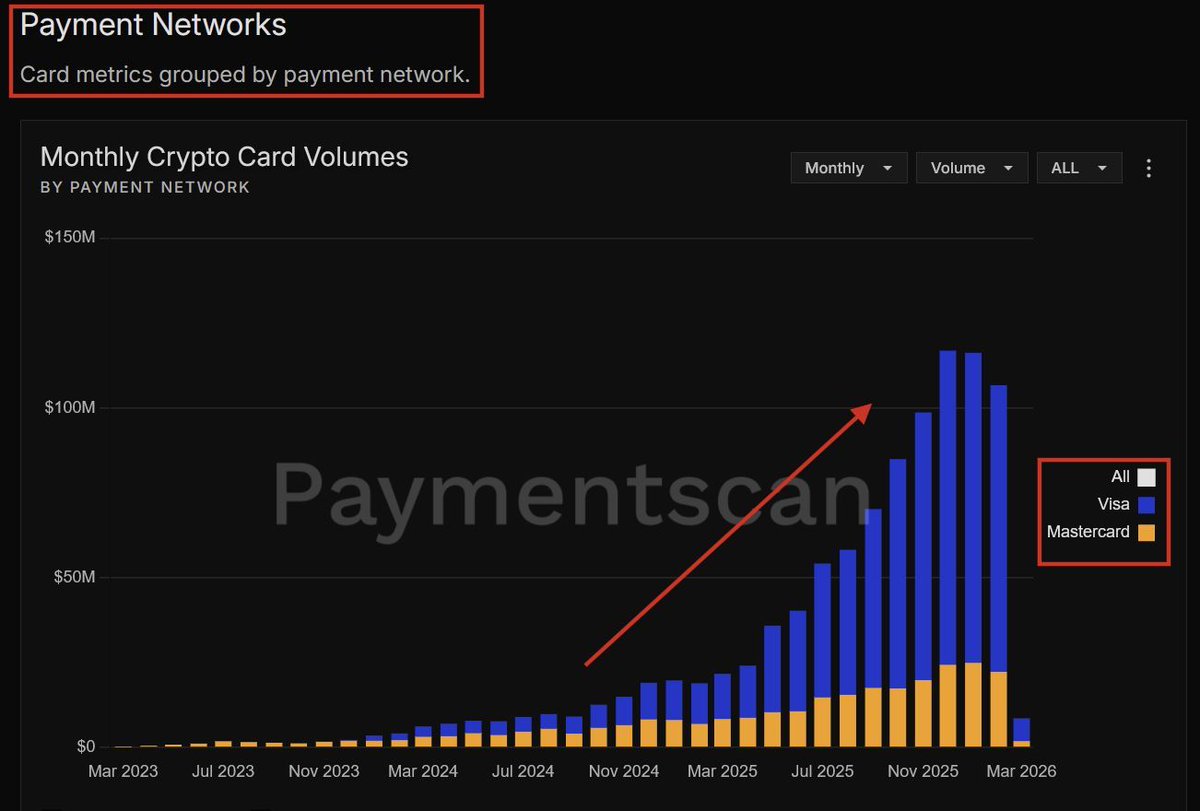
The volume gap is the most striking because it is disproportionate to the user gap. Visa has 22% more users than Mastercard but processes 161% more volume. That means Visa crypto cardholders are spending significantly more per transaction than Mastercard crypto cardholders, not just more frequently. The average Visa crypto card transaction is materially larger than the average Mastercard one.
What the Chart Shows Over Time
The Paymentscan monthly chart runs from March 2023 through early 2026. For the first eighteen months, both networks ran at near-zero crypto card volume, barely visible on the chart. The divergence began around mid-2024 and accelerated sharply from November 2024 onward. By November 2025 Visa was processing over $140 million in a single month. The blue Visa bars dominate every month in the chart’s right half while the orange Mastercard bars remain a fraction of the total.
The timing of the acceleration aligns with the broader crypto adoption wave that followed the spot Bitcoin ETF approvals in January 2024 and the subsequent bull market cycle. As crypto portfolios appreciated, cardholders with crypto-linked spending cards increased their usage. Visa captured the majority of that growth.
Why Visa Is Winning
Visa’s early and aggressive partnerships with crypto-native companies gave it the distribution advantage that the volume data now reflects. Coinbase’s Visa card, Crypto.com’s Visa card, and multiple other major crypto platform cards run on Visa rails. Mastercard has equivalent partnerships but fewer of the highest-volume platforms.
The network effect compounds over time. More crypto platforms choosing Visa means more users defaulting to Visa crypto cards, which means more transaction data and negotiating leverage for Visa when signing new partnerships. Mastercard is not losing the crypto card market entirely. It is losing it by a margin that suggests the gap is structural rather than temporary.