


Coinbase has signed a definitive agreement to acquire The Clearing Company, marking another step in its push to transform into what executives have described as an “Everything Exchange.”
While the financial terms were not disclosed, a recent report characterized the deal value as immaterial, underscoring that the strategic value lies more in capability than in scale.
The acquisition comes just days after Coinbase rolled out prediction markets on its platform, signaling a rapid and deliberate expansion into event-based trading.
A Broader Vision for the Coinbase Platform
The deal fits squarely within Coinbase’s long-term strategy to offer a single, unified trading venue for multiple asset classes. Beyond crypto, the company has been steadily laying groundwork to support equities, derivatives, and now prediction markets, allowing users to trade outcomes tied to elections, sports, and macroeconomic events.
By integrating prediction markets directly into its ecosystem, Coinbase aims to reduce friction for users who currently rely on fragmented platforms to access different types of financial exposure.

Expertise Built for Scaling Event-Based Markets
The Clearing Company brings a team with deep operational experience in prediction markets. Its founders and engineers have previously worked on platforms such as Polymarket and Kalshi, giving Coinbase immediate institutional knowledge in a complex and highly regulated niche.
That expertise is expected to help Coinbase scale liquidity, risk management, and settlement infrastructure as prediction markets are integrated more tightly into the platform.
Regulatory-First Approach to Prediction Markets
A key element of the acquisition is regulatory positioning. Prior to the deal, The Clearing Company had applied to become a derivatives clearing organization with the Commodity Futures Trading Commission, highlighting an explicit focus on compliant, regulated event-based markets.
This aligns with Coinbase’s broader approach of expanding product offerings while remaining within U.S. regulatory frameworks, particularly important as prediction markets increasingly draw scrutiny from policymakers.
Timeline and Market Response
The transaction is expected to close in January 2026, pending customary conditions. Once finalized, it will accelerate Coinbase’s roadmap for prediction markets, which only launched publicly on the platform last week.
Investors reacted positively to the announcement. Following the news on December 22, 2025, Coinbase shares rose more than 3% in morning trading, with the stock hovering around $252.49.
What This Signals Going Forward
Coinbase’s acquisition of The Clearing Company highlights how aggressively the company is moving to broaden its product scope. Prediction markets, once viewed as niche or experimental, are now being positioned alongside core trading products on one of the largest regulated crypto platforms.
The move reinforces a clear message: Coinbase is no longer building just a crypto exchange. It is assembling the infrastructure to support a wide spectrum of market activity, with regulated, on-chain prediction markets now firmly part of that vision.
Prediction Markets Volume Surges as Liquidity Floods In
A recent chart shared by Coinbase, visible in the lower-left corner of the image, illustrates just how quickly prediction markets have moved from the margins into the mainstream. Weekly trading volumes were almost negligible in mid-2024, but began accelerating sharply toward the end of last year, with notable spikes around major political and macro events.
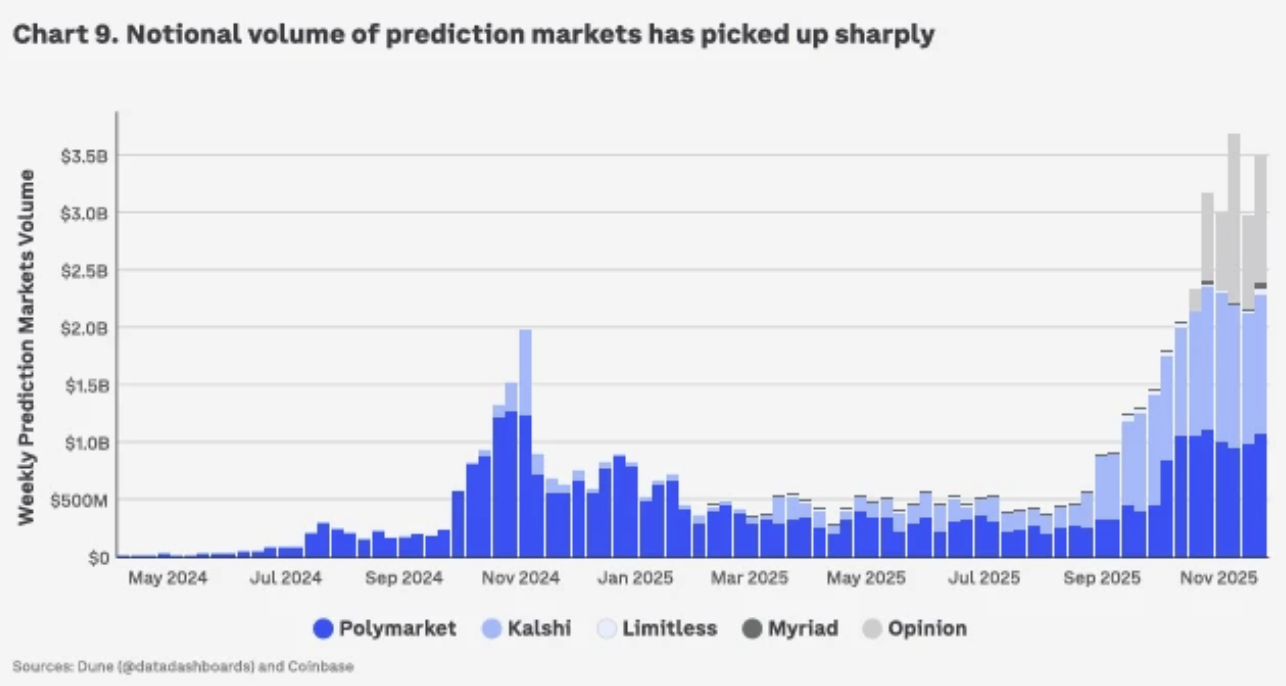
After a brief cooldown in early 2025, activity picked up again and surged to multi-billion-dollar weekly volumes by late 2025. Polymarket and Kalshi remain the dominant drivers, while newer platforms such as Limitless and Opinion are adding fresh momentum to the space.
This explosive growth shows that prediction markets are no longer a short-lived trend, but a rapidly scaling market with real liquidity, helping explain why Coinbase is moving quickly to secure a foothold as demand and capital continue to flow in.