





Uniswap governance is approaching a landmark moment as a major proposal known as “UNIfication” moves toward final approval.
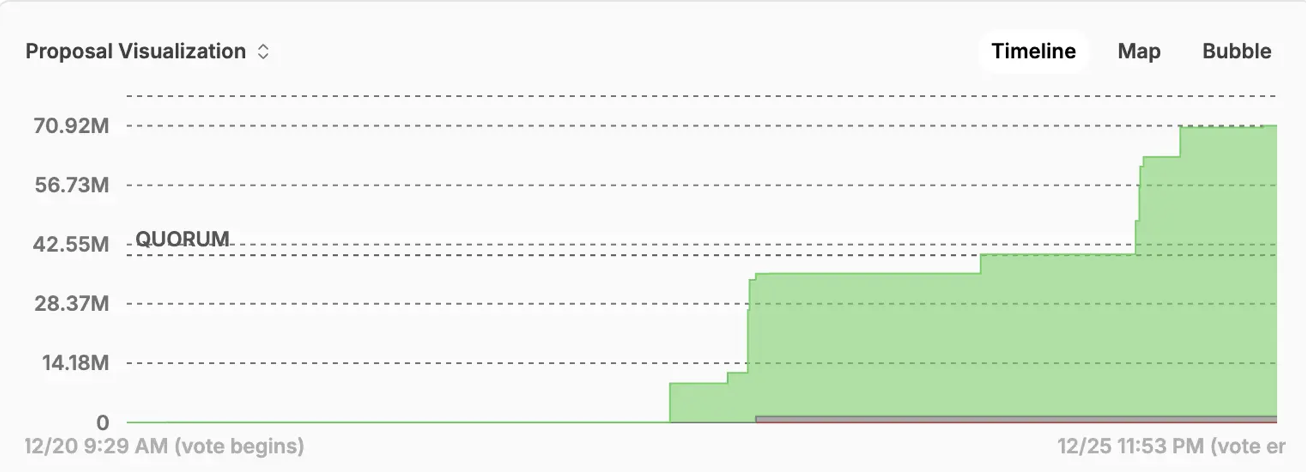
As of December 22, 2025, nearly 99% of participating voters have backed the initiative, signaling overwhelming support for a fundamental shift in how the UNI token functions within the ecosystem.
If implemented, the proposal would mark Uniswap’s transition from a purely governance-driven token model to one where UNI directly accrues value from protocol activity. The change would represent one of the most significant economic realignments in Uniswap’s history.
From Governance Token to Revenue-Linked Asset
At the core of the proposal is the long-debated protocol fee switch. Under the new structure, a portion of trading fees generated on Uniswap would be redirected from select pools into a UNI burn mechanism. For Uniswap v3 pools, roughly one-sixth of trading fees would be captured, while Uniswap v2 pools would contribute a fixed 0.05% fee.
This mechanism directly ties UNI’s supply dynamics to platform usage. As trading volume increases, more tokens would be removed from circulation, introducing a structural deflationary pressure that scales with activity across the protocol.
A Nearly $1 Billion Treasury Burn
In addition to ongoing fee-based burns, the proposal includes a one-time destruction of 100 million UNI tokens held in the treasury. At current market prices, this burn is valued at approximately $940 million, instantly reducing circulating supply and permanently removing a significant overhang from the market.
This treasury action is designed to reinforce the shift toward long-term token value rather than treasury accumulation, aligning governance incentives with token holders.

Sustained Deflation Through Protocol Activity
Beyond the initial burn, analysts estimate that the activated fee switch could result in approximately $130 million worth of UNI being burned annually, assuming current trading volumes remain stable. This introduces a predictable, usage-driven deflation model that contrasts sharply with UNI’s historical inflationary issuance.
The burn mechanism will also extend to Unichain, Uniswap’s recently launched network. Fees generated by the Unichain sequencer will be routed into the same burn system, further integrating UNI’s economics across Uniswap’s expanding infrastructure.
Uniswap’s Internal Economic Realignment
The proposal also reshapes Uniswap’s internal structure. Uniswap Labs and the Uniswap Foundation would operate under a single unified economic model, ending fragmented fee and revenue arrangements.
Under the new framework, Uniswap Labs will focus exclusively on product development, growth, and distribution. Starting in 2026, Labs will receive a fixed annual allocation of 20 million UNI to fund operations, while giving up separate interface and wallet fees. This simplifies incentives and ensures protocol growth directly benefits the UNI token economy.
Timeline and What Comes Next
On-chain voting is scheduled to conclude on December 25, 2025, with finalization potentially occurring in the early hours of December 26 depending on time zones. If the proposal passes, a mandatory two-day timelock period will follow before execution.
Once the timelock expires, the protocol fee switch, treasury burn, and economic restructuring are expected to be implemented later this week.
Market Reaction and Broader Implications
The market has already responded decisively. Since the vote opened, UNI has surged roughly 25%, pushing the token above $6.00 as traders and investors priced in the shift toward revenue-backed token economics.
More broadly, UNIfication positions Uniswap alongside a growing class of protocols that directly link token value to cash flows and usage. If successful, it could set a precedent for decentralized exchanges seeking to balance decentralization, sustainability, and long-term tokenholder alignment.
With final approval imminent, UNI now stands at the threshold of its most consequential transformation to date.



